
Carrier Air Duct Cleaning in Great Kills, NY | Landmark Air Duct Cleaning Service New York
Carrier air duct cleaning in Great Kills typically runs $350–$850 for a full system depending on your home’s duct configuration and whether Sandy flood residue is present in the lines. We provide Carrier sales & service as an independent provider — not manufacturer-authorized — and Richard Anderson, our owner and lead technician, handles every job personally with 20 years of duct-specific experience. If you’re in the 10308 ZIP or anywhere near Great Kills Harbor, call (833) 754-6107 for a free estimate and same-day scheduling.
Why Great Kills Residents Choose Us for Carrier Service
Richard Anderson — owner and lead technician — handles your job personally. That matters in Great Kills, where your Carrier system faces conditions no Carrier in Midland Beach or inland manual ever prepared it for.
We don’t send franchise crews who rotate through neighborhoods with a checklist. Richard grew up in Woodside, Queens, learned HVAC mechanics at New York City College of Technology in Brooklyn, and has spent two decades pulling apart ductwork in exactly the kind of post-war ranches and split-levels that dominate Great Kills. He knows the original sheet-metal chases routed through crawl spaces here, the way salt air corrodes register boots near the harbor, and what a proper video inspection should reveal when Sandy residue is still hiding in dead-end branches.
Our equipment comes from Rotobrush, Nikro, and Abatement Technologies — the same brands commercial contractors use, not the stripped-down rigs most residential crews haul around. And with 548 verified reviews averaging 4.9 stars, you can check our track record before you book. “I’ll tell you what you need. I won’t sell you what you don’t.” That’s how Richard built this business, one referral at a time.
Common Carrier Air Duct Cleaning Problems We Solve in Great Kills
- Corroded supply register boots from salt-laden bay air. Homes within a few blocks of Great Kills Harbor — especially along Brighton Street and the surrounding harbor neighborhood — see accelerated corrosion on Carrier register boots and flanges. The salt pulls moisture from humid air, rusting metal joints until they leak conditioned air and pull in crawl-space debris. We replace with OEM Carrier boots where the seal is critical, and use aftermarket marine-grade sealants on non-critical connections.
- Clogged evaporator coils carrying Sandy sediment residue. Fine sediment from the 2012 flood — silt, heating oil particulate, organic matter — can linger in below-slab ductwork for years, slowly breaking free and coating your Carrier Performance or Infinity series coil. We’ve measured airflow drops of 25–30% in these systems. Our cleaning protocol includes coil-specific HEPA agitation and antimicrobial treatment, not just a surface wipe.
- Flex-duct liner delamination in attic runs. Great Kills attics hit 130°F in July and drop below freezing in January. That swing, combined with coastal humidity, separates the inner liner from flex-duct insulation in Carrier systems with attic distribution. The liner sags, traps condensation, and becomes a mold vector. We video-map every attic run before cleaning to spot delamination you can’t see from the register.
- Mastic joint failures in sheet-metal trunks. Persistent moisture from Raritan Bay humidity degrades mastic seals in the original 1950s–1970s ductwork common in Great Kills. Unconditioned humid air leaks in, your Carrier blower works harder, and energy bills climb. We reseal with proper duct mastic and mechanical fasteners, not tape that’ll peel in two seasons.
- Biofilm buildup in return plenums from wicking groundwater. Even elevated homes from the Build It Back program often kept original basement or below-floor returns. Groundwater wicks through unsealed rim joists, and the dark, humid plenum grows biofilm that no standard filter catches. We hand-rod these sections with HEPA vacuum extraction — the only method that removes embedded growth without spreading it.
Carrier Service in Great Kills: What Local Conditions Mean for Your Equipment
Great Kills, situated on the south shore of Staten Island, was among the hardest-hit areas during Hurricane Sandy when contaminated Raritan Bay water — carrying raw sewage, heating oil, and sediment — flooded thousands of homes. Even rebuilt homes under NYC’s Build It Back program often retained original below-floor or basement ductwork, leaving a legacy of mold, hydrocarbon residues, and microbial contamination that standard residential cleaning protocols do not address, making thorough video inspections and hand-rodding essential for Carrier systems here.
Here’s what that means if you own a Carrier. That Infinity 24VNA9 or Performance 24ABC6 in your ranch on Hylan Boulevard? Its blower motor and control board might be pristine, but the return trunk could be circulating contaminants your family has been breathing since 2012. Carrier’s factory engineers never designed for flood-bay hydrocarbon exposure. The aluminum coils handle it better than cheap brands, but the mastic seals and flex connections weren’t built for years of salt-air cycling after submersion. We treat Carrier systems in Great Kills differently because they need to be treated differently — starting with a video inspection that maps every branch, not just the accessible ones.
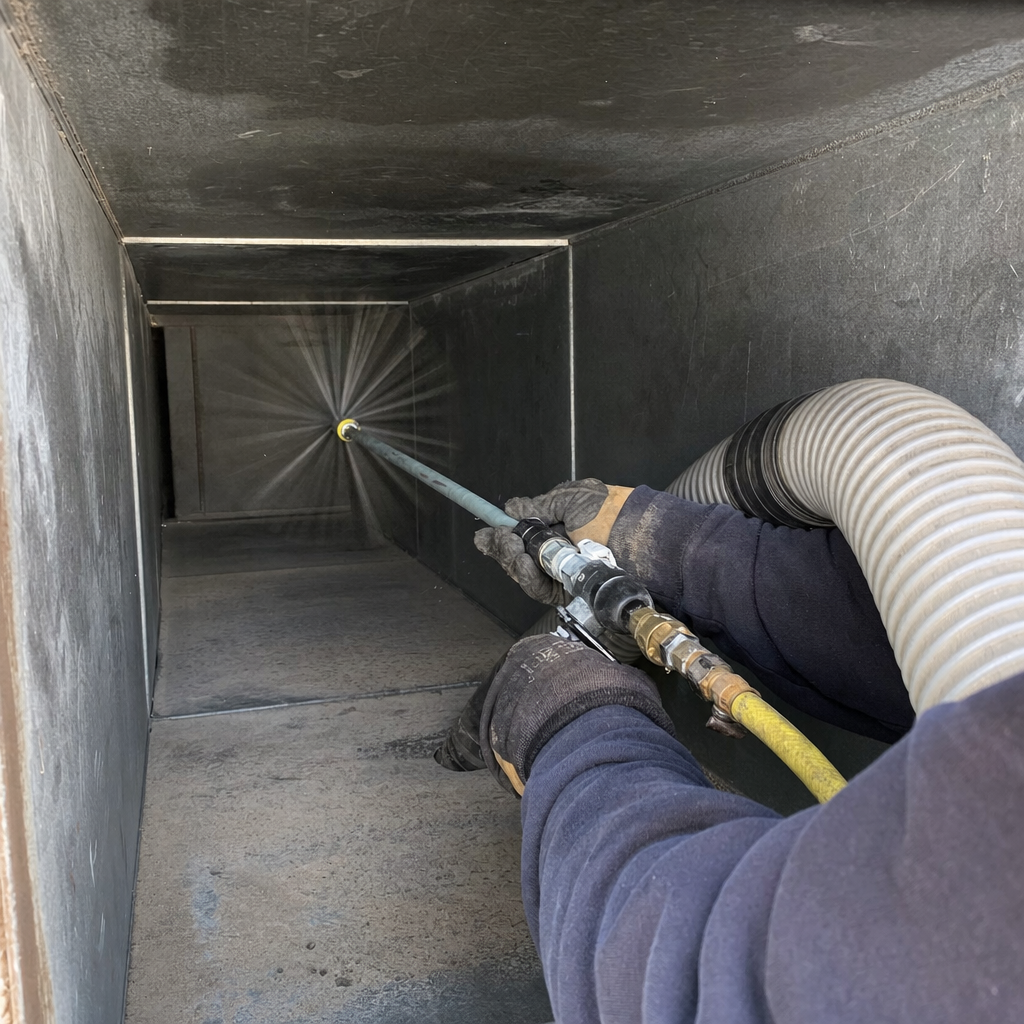
On a recent job on Brighton Street in the Great Kills Harbor neighborhood, our crew found a Carrier Infinity 24VNA9 system with a salt-laden tide-line stain visible inside the supply trunk — a clear ghost mark from Hurricane Sandy’s flood level. The return plenum had a thick biofilm from years of wicking groundwater through unsealed rim joists. We performed a full video inspection to map all dead-end branches, then manually hand-rodded the main trunk with HEPA vacuum agitation to remove embedded sediment, followed by antimicrobial coil treatment to prevent recurrence.
Carrier Models & Products We Service in Great Kills
We work on the full Carrier residential lineup: Infinity Series (24VNA9, 25VNA8), Performance Series (24ABC6, 25HCE4), Comfort Series (24ABB3, 25HBB3), and Base Series (24ACB3). Each has distinct duct configurations, airflow dynamics, and common failure points in coastal environments like Great Kills.
For critical components — blower motors, control boards, pressure switches — we source OEM Carrier parts. The Infinity’s variable-speed ECM motor, for instance, requires exact factory spec to maintain its SEER rating. For non-critical items like duct sealing materials, register boots, or flex-duct replacement, we use high-quality aftermarket alternatives that meet or exceed Carrier’s operational requirements. We stock common OEM parts locally for Great Kills jobs and Carrier service in Oakwood, so you’re not waiting a week for a motor while your system circulates bay air.
Carrier Service Pricing in Great Kills
Most Carrier our Air Duct Cleaning in Great Kills jobs fall between $350 and $850. Here’s how that breaks down:
- Basic cleaning (ranch/small cape, accessible ducts, no flood damage): $350–$500
- Full system with video inspection and coil cleaning: $500–$700
- Sandy-impacted systems requiring hand-rodding, antimicrobial treatment, and seal repair: $700–$850+
- Duct sealing as add-on service: $200–$400 additional
What drives cost? Duct accessibility (crawl space vs. basement), number of supply/return branches, presence of flood residue requiring remediation-level cleaning, and whether your Carrier system needs coil or blower service alongside ductwork. Every estimate we provide in Great Kills includes a full video inspection — no charge, no obligation. Call (833) 754-6107 and Richard will walk you through what your specific Carrier setup likely needs.
Serving Great Kills, NY — Our Local Coverage Area
We’re based in the Great Kills area and know this community well. Use the map below to see our service coverage — if you’re nearby, we can almost certainly help.
FAQs — Carrier Air Duct Cleaning in Great Kills
The flood line often hides inside the duct, not on the wall. We look for tide-line staining on sheet-metal interiors, rust patterns at consistent heights across multiple boots, and sediment deposits in dead-end branches that standard cleaning never reached. A video inspection reveals what finished drywall conceals. If your home was built before 1980 and sits below Richmond Road’s elevation contour, odds are good some original ductwork remains. Call (833) 754-6107 for a free video inspection — we’ll show you exactly what’s in there.
Yes, and in Great Kills it’s often two problems叠加. First, the Infinity’s variable-speed blower compensates for duct leakage by ramping up, which masks gradual seal degradation until bedroom airflow drops noticeably. Second, attic flex-duct runs in split-levels common here delaminate from temperature swings, effectively shrinking your duct diameter. We video-map the full path from air handler to register to find the restriction. Most Infinity airflow issues we diagnose in Great Kills are duct-related, not blower failure.
Restricted airflow from a dirty coil or low refrigerant are the usual suspects, but in Great Kills there’s a third: fine sediment from Sandy residue coating the coil fins, reducing heat transfer until ice builds. We’ve pulled coils in Performance 24ABC6 units here with 1/16-inch sediment layers that standard filter changes never address. The fix is proper coil cleaning with HEPA-contained agitation, not a foaming spray from a big-box store that pushes debris deeper. We also offer Dryer Vent Cleaning in Great Kills using the same contained methods. If your Performance system freezes annually, the coil needs inspection.
Not necessarily annually — every 2–3 years is typical for well-maintained systems — but Great Kills’ coastal conditions do accelerate certain problems. Salt air corrodes metal joints faster than inland. Humidity keeps biofilm viable longer. If your system has any Sandy flood history, we’d want to inspect yearly until we confirm the contamination is fully cleared. Richard assesses each Carrier system individually — including Carrier repair in New Dorp — rather than selling a maintenance contract you don’t need. Call (833) 754-6107 and he’ll tell you straight what your schedule should be.
Maybe. If the ductwork is original 1950s–1970s sheet metal with Sandy exposure, replacement during renovation is far cheaper than accessing it later. But Carrier equipment is built for 15–20 years of service, and if your blower and coil are sound, selective repair and sealing of existing ducts often makes more sense. We never recommend replacement for replacement’s sake. Richard will inspect what you’ve got, show you the video, and give you a repair-vs-replace number based on actual condition — not a sales target.
Service Areas Near Great Kills
We handle Carrier systems across Staten Island’s south shore and beyond. Nearby areas we regularly service include Eltingville Carrier service, plus Gramercy Park and Hell’s Kitchen in Manhattan for our commercial clients, and East Village properties with aging duct infrastructure. While our Great Kills focus keeps Richard busy with the unique post-Sandy challenges here, we’re equipped to travel for Carrier jobs throughout the boroughs.
Book Your Carrier Service in Great Kills Today
Your Carrier system was built to last. In Great Kills, it just needs someone who understands what the Raritan Bay has put it through. Richard Anderson handles every estimate, every inspection, every cleaning personally — no subcontractors, no franchise rotation. Same-day appointments available when urgency matters. Call (833) 754-6107 for your free estimate.
Written by Richard Anderson, Owner & Lead Technician at Landmark Air Duct Cleaning Service New York, serving Great Kills and all of New York since 2004.