
How Often to Clean Air Ducts in New York: A Realistic Schedule for City Living
Most homes should have air ducts cleaned every 3 to 5 years, but in New York City, the honest answer is closer to every 2 to 4 years for typical apartments and townhouses — and sooner if you’ve renovated, own pets, or live in a pre-war building with original ductwork. If you’re asking Is Air Duct Cleaning Worth It? (New York, NY), the factors above are why local timing differs from national guidelines. The standard national guideline assumes suburban single-family homes with central HVAC systems and minimal environmental load. It doesn’t account for Manhattan’s PM2.5 levels, Queens’ pollen corridors, or the way a 1920s Brownstone in Brooklyn forces air through galvanized steel that’s been collecting debris since the Reagan administration. If you’re unsure where your system falls, call (833) 754-6107 and we’ll give you a straight assessment — no charge, no pressure.
Richard Anderson — owner and lead technician at home — grew up in Woodside, Queens, a few blocks from the elevated 7 train, and has spent the last 20 years cleaning air ducts in just about every type of building New York throws at you. Pre-war walk-ups, high-rise condos with fan coil units, commercial kitchens in the Flatiron District, you name it. He learned the mechanical side of HVAC systems at New York City College of Technology in Brooklyn, where hands-on coursework gave him a foundation that held up a lot better than the sheet metal in some of the ducts he’s pulled apart since. That background shapes how we answer the frequency question: not with a calendar date, but with what we actually find when we open the system.
Why New York’s Environment Changes the Math
Three to five years is a fine rule of thumb if you live in a ranch house in Arizona and haven’t touched your ductwork since it was installed. It’s less useful if you’re in a two-bedroom in Astoria that just had a full kitchen renovation, three cats, and windows that open onto a street with a demolition project. Context is everything.
New York City’s air carries a particulate load that suburban NADCA guidelines simply weren’t built around. Street-level apartments in neighborhoods like the Lower East Side, Harlem, or Sunset Park pull in diesel particulates, construction dust, and seasonal pollen that settle in return ducts differently than in a house with a yard buffer. We’ve opened systems in Midtown high-rises where the return registers were caked with black residue from decades of street-level air cycling through — not mold, not construction debris, just the accumulated signature of urban living.
Then there’s the building stock. New York’s housing spans roughly 150 years of construction methods, and duct systems vary wildly:
- Pre-war buildings (pre-1945): Often have unlined galvanized steel ducts, sometimes with asbestos insulation on the exterior. These systems accumulate debris in seams and corners that modern smooth-wall ducting doesn’t have. Frequency: every 2–3 years, with careful inspection for deterioration.
- Post-war mid-rise (1945–1980): Typically sheet metal with fiberglass lining. The lining traps debris and can degrade, releasing fibers. Frequency: every 2–3 years, with attention to lining condition.
- High-rise condos (1980–present): Often use fan coil units or PTAC systems that recirculate room air in a closed loop. These accumulate debris faster than central systems with large return ducts because there’s less dilution. Frequency: every 1.5–2.5 years for fan coil units.
- New construction or gut renovation (2000–present): Modern flex duct or rigid metal, but often contaminated with construction debris if not protected during build. Frequency: clean immediately post-construction, then every 3–4 years.
The moisture profile matters too. Basement-level systems in neighborhoods with high water tables — parts of Gowanus, Red Hook, certain blocks in the Bronx — can develop condensation issues that accelerate debris accumulation and microbial growth. We’ve pulled apart ductwork in Crown Heights basements where the combination of moisture and decades of neglect had created a layer of compacted debris that reduced airflow by 30 percent. That’s not a hypothetical — that’s a measured pressure differential on a Rotobrush system with digital airflow monitoring.
What Actually Accelerates Your Cleaning Schedule
After 548 verified reviews and 20 years of documented jobs, we’ve identified the specific factors that push a New York system from “check it in three years” to “clean it now.” Here’s what moves the needle:
| Accelerator Factor | Typical Impact on Frequency | What We Find on Inspection |
|---|---|---|
| Post-renovation (any gut work) | Clean immediately, regardless of last service date | Drywall dust, insulation fragments, sawdust in main trunk lines |
| Pet ownership (especially multiple pets in under 1,000 sq ft) | Every 2 years vs. every 3–4 | Hair accumulation in return registers, dander coating duct walls |
| Street-level apartment with operable windows | Every 2–2.5 years | Elevated particulate load, pollen, urban grime |
| Pre-war building with original ductwork | Every 2 years with inspection | Corrosion, seam separation, possible asbestos exterior |
| Smoking indoors (current or previous tenant) | Clean immediately, then every 2 years | Tar residue, persistent odor, sticky particulate layer |
| Recent water damage or leak | Inspect immediately, clean if contamination confirmed | Moisture staining, potential microbial growth, debris clumping |
The renovation factor is non-negotiable. We’ve lost count of how many Upper West Side co-op owners called us six months after a kitchen gut, wondering why their “new” HVAC system was wheezing. The answer was always the same: the contractor ran the system during construction to “keep air moving,” and the filters were either removed or overwhelmed. Drywall dust is fine enough to pass through standard filters and deposit in the main trunk. If you’ve had walls opened, floors refinished, or any significant demolition, you need a post-construction cleaning — not a suggestion, a requirement.
Pet density in small spaces is another New York-specific accelerant. A single cat in a 2,000-square-foot house in Westchester is a different proposition than three cats in a 700-square-foot East Village walk-up. The hair load concentrates, the dander recirculates through a smaller volume, and the filters clog faster. We’ve pulled enough pet hair from return ducts to stuff a pillow — not an exaggeration, a measured observation from a Park Slope job where the homeowner’s allergies cleared within 48 hours of cleaning.
How Richard Anderson Determines If You Actually Need Cleaning Now
“I’ll tell you what you need. I won’t sell you what you don’t.” That’s the standard Richard applies on every assessment, and it’s why our 4.9-star rating across 548 reviews hasn’t budged in years. Here’s what he actually looks for when he opens a system:
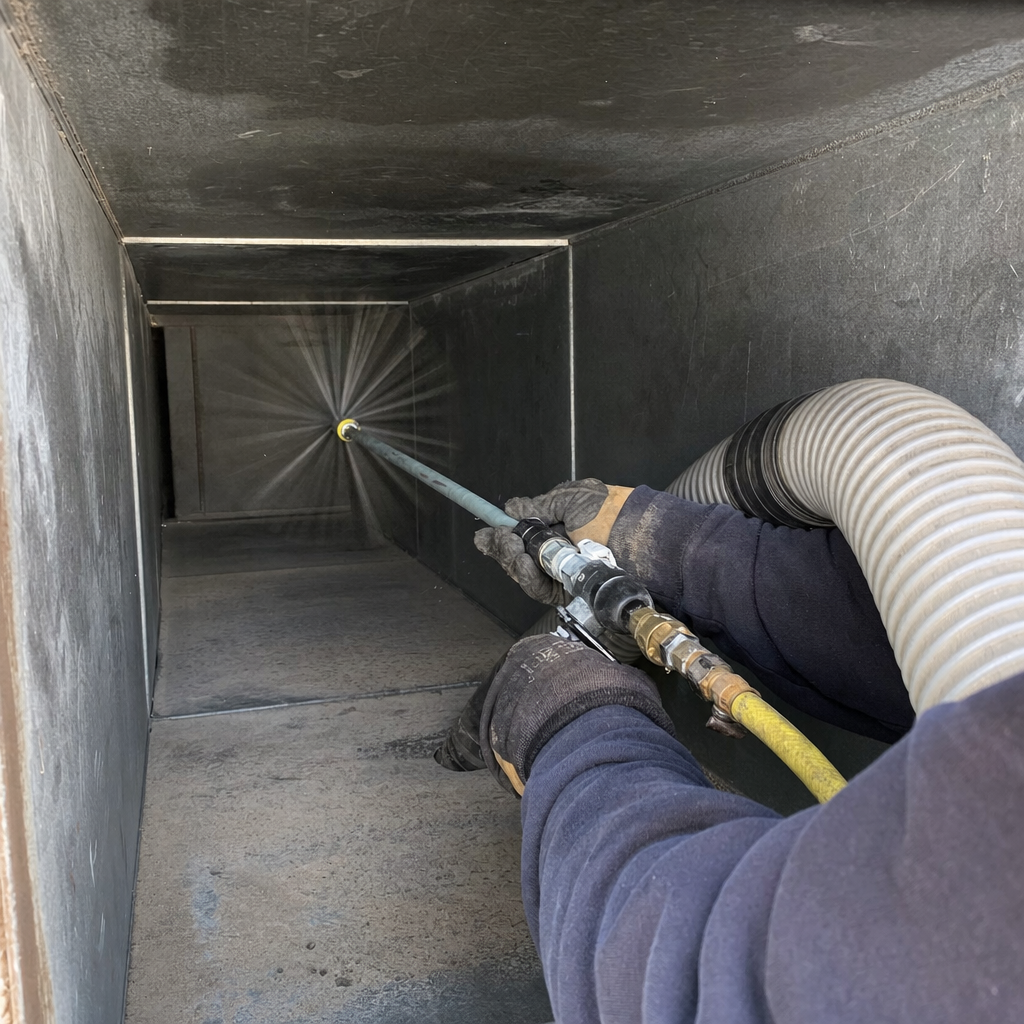
Visual inspection of the main trunk and primary branches. We use a borescope camera — contractor-grade equipment from Nikro and Abatement Technologies — to examine duct interiors without disassembly. If the walls show a uniform coating of dust and debris more than 1/16 inch thick, that’s a cleaning indicator. Less than that, and we’re honest about waiting.
Register and boot condition. The boots (the metal connections between duct and register) often accumulate debris faster than the main lines because airflow slows at the transition. Heavy buildup here suggests the system needs attention even if the trunk looks acceptable.
Filter history and type. A homeowner using cheap fiberglass filters and changing them irregularly will have dirtier ducts than someone with pleated MERV 8–11 filters on a quarterly schedule. This isn’t judgment — it’s diagnostic data that shapes the recommendation.
System age and material. Original 1920s galvanized steel in a Washington Heights building gets a different risk assessment than 2015 flex duct in a Long Island City condo. Older metal can corrode, creating pockets where debris compacts and airflow degrades.
Occupant symptoms. Persistent allergies that improve when the resident leaves home, unexplained odors when the system runs, or visible dust emission from registers — these are clinical correlates, not proof, but they factor into the overall picture.
The assessment itself answers the frequency question. We’ve told Park Avenue co-op boards their system was fine for another two years. We’ve told Crown Heights homeowners their “recent” cleaning was visibly incomplete and needed redoing. The tool doesn’t matter if the operator treats every job as an invoice opportunity rather than a diagnostic exercise.
What Happens If You Wait Too Long — And What “Too Long” Looks Like in NYC
Deferring duct cleaning doesn’t cause catastrophic failure. That’s not how this works. What it does is gradually degrade system efficiency, increase particulate circulation, and in some cases create conditions where more expensive interventions become necessary.
We’ve documented the progression across our 20-year dataset:
- Years 1–3 (post-cleaning): System operates at designed airflow. Filters capture nominal load. No occupant complaints.
- Years 3–5 (typical suburban guideline): Moderate debris accumulation. Airflow reduction of 5–10 percent. Filters clog faster. Allergy-sensitive occupants may notice symptoms. In New York’s environment, this stage often arrives by year 2–3.
- Years 5–8 (common deferral): Significant buildup. Airflow reduction of 15–25 percent. HVAC system works harder, shortening component life. Dust emission from registers visible. Odor potential increases. This is where we find most “overdue” New York systems.
- Beyond 8 years (neglect): Severe compaction possible, especially in pre-war systems with internal seams. Potential for moisture retention and microbial growth. Duct repair or partial replacement may be needed. We’ve replaced sections of ductwork in Queens basements where corrosion and debris had essentially sealed the line.
The cost differential matters. A standard Air Duct Cleaning in a typical New York apartment runs $300–$600 depending on system complexity. Duct repair or replacement, which becomes more likely with long deferral, starts at $800 and can exceed $2,500 for extensive work. The math isn’t complicated.
High-Rise vs. Low-Rise: Why Your Building Type Changes Everything
This is the detail most national guides miss entirely, and it’s critical for New York’s housing mix.
High-rise fan coil and PTAC systems recirculate room air through a localized unit — there’s no building-wide duct network in the traditional sense. These units have small internal coils and blowers that accumulate debris rapidly because the same limited air volume passes through repeatedly. We’ve opened fan coil units in Financial District towers where the blower wheel was so coated that airflow was reduced by 40 percent. The tenant had been told for three years that “the building handles HVAC maintenance.” The building’s contract covered filter changes, not deep cleaning. Frequency for these systems: every 1–2 years for the unit itself, which is a different service scope than full duct cleaning but equally important for air quality.
Low-rise and townhouse central systems behave more like suburban installations but with urban particulate load. A Brownstone in Bedford-Stuyvesant with basement mechanical room and ductwork running to three floors has real return ducts, real trunk lines, real accumulation patterns. These systems can follow closer to standard guidelines — 3 years if conditions are favorable — but building age and renovation history usually pull that earlier.
Co-op and condo shared systems present the trickiest assessment. The building may maintain central boilers and chillers, but individual unit ductwork is the shareholder’s responsibility. We’ve worked with co-op boards in the West Village and Upper East Side to develop cleaning schedules that align individual unit work with building-wide maintenance. The coordination matters — cleaning your ducts two weeks before the building flushes the risers is poor timing.
What Professional Duct Cleaning Actually Costs in New York
Price transparency helps you evaluate whether a quoted frequency is genuine advice or a sales tactic, and understanding Whole House Air Duct Cleaning Cost in New York, NY makes that easier. Here’s what Landmark charges for residential duct cleaning in the five boroughs, based on system type and verified across our 548-review history:
| Service Scope | Typical New York Range | What Drives the Variation |
|---|---|---|
| Standard apartment (1–2 bedrooms, single system) | $300–$450 | Register count, accessibility, contamination level |
| Large apartment or townhouse (3+ bedrooms, multi-zone) | $450–$700 | Zone count, duct material, system complexity |
| Post-renovation cleaning | $400–$650 | Construction debris load, filter protection during build |
| Fan coil / PTAC unit deep cleaning | $200–$350 per unit | Unit accessibility, coil condition, blower wheel buildup |
| Duct repair or sealing (when needed) | $150–$400 per section | Access difficulty, material match, extent of damage |
These are our actual price ranges, not teaser rates. We use contractor-grade Rotobrush and Abatement Technologies systems — the same equipment specification we’d bring to a commercial job — because residential ductwork in New York often presents challenges (tight access, older materials, unexpected construction debris) that consumer-grade equipment can’t handle properly.
We also integrate and service Honeywell, Aprilaire, and Guardsman air quality systems when they’re part of your setup. If your duct cleaning reveals that the whole-house humidifier or air purifier needs attention, that’s handled in the same visit — one call closes the loop on your air quality.
Key Takeaways: Your New York Duct Cleaning Schedule
- Baseline for NYC: Every 2–4 years, not the generic 3–5 — urban particulate load accelerates accumulation.
- Clean immediately after: Any renovation with open walls, floors, or significant dust generation.
- Accelerate to every 2 years if: Multiple pets in small space, street-level apartment with operable windows, pre-war building with original ductwork, indoor smoking history.
- High-rise fan coil/PTAC: Every 1–2 years for the unit itself — these are not “set it and forget it” systems.
- Get an honest assessment: Borescope inspection should show you actual duct condition, not just a verbal recommendation.
- Richard Anderson handles your job personally: Owner and lead technician, not a subcontractor rotation — the accountability difference matters.
FAQs
Affordable Air Duct Cleaning in New York, NY typically runs $300–$700 for residential systems, depending on apartment size, system complexity, and contamination level. A standard one-bedroom with a single system usually falls in the $300–$450 range, while multi-zone townhouses or post-renovation cleanings run higher. Call (833) 754-6107 for a free, exact quote based on your specific setup — estimates are free, and we’ll tell you honestly if you can wait.
Repair is almost always cheaper than full replacement for localized issues — typically $150–$400 per section versus $2,000+ for extensive replacement. However, pre-war buildings with widespread galvanized steel deterioration sometimes reach a tipping point where sectional repairs become a patchwork that costs more long-term. Richard Anderson assesses this on-site with borescope imaging and airflow measurement, giving you the actual data rather than a generic recommendation. Call (833) 754-6107 to schedule an inspection.
Same-day service is often available for urgent situations — post-renovation moves, allergy flare-ups, or real estate transactions — though we typically book 2–3 days out for standard appointments. Emergency scheduling carries no premium; we don’t upcharge for urgency. If your situation is time-sensitive, mention it when you call (833) 754-6107 and we’ll fit you in or direct you to the next available slot.
A proper cleaning should leave visible debris removed from registers and boots, documented with before/after borescope imagery, and measurable airflow improvement if the system was significantly restricted. We provide digital documentation on request and welcome you to inspect the ductwork with us during the job. If a previous cleaner spent 45 minutes in your home and left no evidence of trunk line access, you likely got a surface-level service — something we see frequently and correct. Call (833) 754-6107 if you suspect a previous cleaning was incomplete; we’ll assess honestly.
If you’d rather have your system looked at than guess at the calendar, Landmark Air Duct Cleaning Service New York offers a no-pressure assessment anywhere in the five boroughs. Richard Anderson — owner and lead technician — handles your job personally, with two decades of duct work and contractor-grade equipment most residential crews never carry. Call (833) 754-6107 for a free estimate.
Written by Richard Anderson, Owner & Lead Technician at Landmark Air Duct Cleaning Service New York, serving New York, NY.