
Last updated July 10, 2026
How to Hire a Air Duct Cleaning Contractor in New York City: A Step-by-Step Guide
The New York City Attorney General’s office has received more complaints about air duct cleaning bait-and-switch pricing than almost any other home service category. The scam follows a predictable script: a phone-room operation quotes $49 for a “whole house special,” sends a crew that dismantles your system, then demands $1,200 to put it back together. We’ve been called in behind these operators for twenty years. This guide gives you the exact questions that separate real specialists from phone-room crews — questions you can ask before anyone crosses your threshold.
Quick Answer
To hire a legitimate air duct cleaning contractor in New York City, verify NADCA membership with active ACR standard compliance, confirm the person quoting your job will be the technician performing the work, and demand a written quote specifying equipment type, line-item scope, and total price before scheduling. The three-call test — comparing how each company handles your initial inquiry — will eliminate most bait-and-switch operators before you spend a dollar.
Table of Contents
- The Bait-and-Switch Playbook: How the NYC Scam Works
- The Three-Call Test: What Legitimate Phone Intake Sounds Like
- NADCA Membership Is a Floor, Not a Ceiling
- How to Read a Quote Document Like a Contractor
- Owner-Operator vs. Subcontractor: Why It Matters in NYC
- Equipment Matters: What the Quote Should Specify
- Your Post-Job Verification Checklist
- Common Mistakes to Avoid
- When to Call a Professional
- Frequently Asked Questions
- The Bottom Line
The Bait-and-Switch Playbook: How the NYC Scam Works
The air duct cleaning scam is so common in New York City because it exploits a genuine information gap. Most homeowners have never watched a proper duct cleaning, so they can’t distinguish legitimate work from theater. The operators know this.
Here’s the playbook we see repeated across Manhattan, Brooklyn, Queens, and the Bronx:
- The $49 hook. A generic website or mailer advertises a “whole house special” at a price that doesn’t cover fuel and labor. The phone room books the appointment with minimal questions.
- The “inspection” upsell. On arrival, the crew — often day-laborers with a rented van — claims your system has “dangerous mold” or “blockages” requiring immediate additional services. They may show you a blurry photo of someone else’s ducts.
- The pressure close. You’re told the work can’t be completed at the quoted price, and your system is now partially disassembled or “contaminated.” Payment pressure intensifies.
- The vanish. Complaints to the company go unanswered. The business name changes. The cycle repeats.
The Attorney General’s 2022 consumer alert specifically named air duct cleaning among the top five home service scams in New York City by complaint volume. The operators thrive because legitimate duct cleaning does require professional equipment and trained labor — costs that can’t be absorbed into a $49 price point without fraud.
Real duct cleaning in New York City typically runs $400–$900 for a standard residential system, with commercial and multi-unit buildings scaling from there. Anyone quoting significantly below this range is either planning to upsell or planning to do surface-level work that won’t improve your air quality.
The Three-Call Test: What Legitimate Phone Intake Sounds Like
Before you invite anyone into your home, call three companies and compare how they handle your inquiry. The differences will be immediate and revealing.
What a call-center operation sounds like:
- Quotes a flat rate within sixty seconds without asking about your system
- Cannot tell you who will perform the work or how long they’ve been with the company
- Has no questions about your building type, duct material, or recent renovations
- Pushes hard for same-day booking with a “limited time” discount
- Cannot explain what equipment will be used or what standard it meets
What legitimate contractor intake sounds like:
- Asks about your building’s age, HVAC system type, and whether you have flexible ductwork or rigid metal ducts
- Inquires about recent renovations — post-construction cleaning requires different approaches than maintenance cleaning
- Asks whether you’ve noticed specific issues: dust accumulation, odors, allergy symptoms, uneven airflow
- Wants to know access conditions: basement clearance, attic access, service panel location
- Explains their process, equipment, and what you should expect to see during the job
In our experience serving New York City since 2006, the buildings that need the most careful assessment are pre-war structures in neighborhoods like the Upper West Side, Park Slope, and Jackson Heights. These often have original galvanized ductwork, limited access panels, and asbestos-containing insulation that requires modified procedures. A contractor who doesn’t ask about building age isn’t planning for these realities.
Richard Anderson — owner and lead technician — handles your job personally, so when you call Landmark Air Duct Cleaning Service New York home, you’re speaking with the person who will actually be in your building.
NADCA Membership Is a Floor, Not a Ceiling
The National Air Duct Cleaners Association (NADCA) maintains the ACR standard — the industry’s recognized benchmark for assessment, cleaning, and restoration of HVAC systems. Membership is worth verifying, but it’s not sufficient by itself.
How to verify NADCA membership:
- Visit NADCA.com and use their member locator — don’t trust a logo on a website
- Confirm the company name matches exactly; some operators use similar names to confuse verification
- Check that membership is current, not lapsed
Follow-up questions that separate real practitioners from logo collectors:
- “Will you follow NADCA ACR 2021 standards on my job, and can I see the pre-cleaning assessment checklist?”
- “What is your negative air machine’s CFM rating, and how do you verify it’s maintaining adequate suction throughout the cleaning?”
- “Do you perform a post-cleaning visual inspection with me present, and do you photo-document the work?”
- “What is your procedure if you discover damaged ductwork or asbestos-containing materials during cleaning?”
We’ve encountered NADCA members in New York City who own the certification but send untrained crews with inadequate equipment. The membership gets them leads; the follow-up questions reveal whether they actually execute to standard. A contractor who becomes defensive or vague when asked about specific ACR procedures is signaling that the membership is marketing, not practice.
Two decades of duct work, not generalist HVAC services, teaches you that standards on paper and standards in practice diverge more often than consumers realize.
How to Read a Quote Document Like a Contractor
A legitimate quote is a scope-of-work document, not a price tag. Here’s what should appear on every air duct cleaning quote in New York City, and what missing items reveal.
Required line items:
| Line Item | What It Should Specify | Red Flag If Missing |
|---|---|---|
| Supply duct cleaning | Number of supply runs, cleaning method (contact or negative air) | Vague “all ducts” language |
| Return duct cleaning | Return trunk and return grill cleaning specified separately | Return system omitted entirely |
| Main trunk lines | Both supply and return trunks, access panel creation if needed | “We’ll see when we get there” |
| Equipment specification | Brand and type: e.g., “Rotobrush brush-and-vac system” or “Nikro negative air machine” | No equipment mentioned |
| Contamination handling | HEPA filtration on vacuum exhaust, containment procedures | No mention of HEPA or containment |
| Final inspection | Post-cleaning visual with customer, photo documentation | “Trust us, it’s clean” |
Language that should trigger immediate rejection:
- “Technician will assess and quote additional services on site” — the classic bait-and-switch setup
- “Price per vent” without defining what constitutes a “vent” — supply, return, or both?
- “Sanitizing included” without EPA-registered product specification — legitimate sanitizing requires specific products for specific contaminants
- “Mold remediation if needed” without mold assessment protocol — this is where $49 becomes $1,400
In New York City’s competitive market, we’ve reviewed competitor quotes that were literally handwritten notes with a single number. That’s not a quote; it’s a trap. A proper quote from Landmark Air Duct Cleaning Service New York specifies every component, every access point, and the exact equipment we’ll bring — because Richard Anderson, owner and lead technician, is the person who wrote it and the person who will execute it.
Owner-Operator vs. Subcontractor: Why It Matters in NYC
New York City’s air duct cleaning market has a specific structural problem: many companies you call are lead-generation operations that assemble crews for individual jobs. The person who sold you on the phone has no relationship to the person in your home, and accountability dissolves when problems arise.
The subcontractor model:
- Phone room or website generates leads, takes deposits
- Job is posted to a network of independent contractors, often selected by availability rather than qualification
- Crew arrives in unmarked or magnet-sign vehicles with rented or inconsistent equipment
- Quality varies dramatically; same company, completely different experience
- Complaints are deflected between the booking company and the subcontractor
The owner-operator model:
- Same person quotes, schedules, performs, and guarantees the work
- Equipment is owned, maintained, and standardized — we use Rotobrush, Nikro, and Abatement Technologies systems we’ve selected and maintained for years
- Reputation is personal, not abstract — 548 customers, 4.9 stars, results you can verify before you book
- Accountability is immediate and non-delegable
In a city where we’ve serviced buildings from Tribeca lofts to Astoria co-ops to Staten Island detached homes, the consistency of knowing exactly who will arrive matters. Building superintendents in particular — who see every contractor in the city cycle through their properties — consistently tell us that owner-operators are the only ones they can hold to a standard.
When you hire Landmark Air Duct Cleaning Service New York, Richard Anderson — owner and lead technician — handles your job personally. Not a franchise. Not a subcontractor network.
Equipment Matters: What the Quote Should Specify
Professional duct cleaning requires specific equipment categories, and a quote that omits equipment type is not a real quote. Here’s what legitimate contractors use, and what corners look like.
Negative air machines: These create suction throughout the duct system, preventing debris from escaping into your living space during cleaning. A proper unit for residential work pulls 2,000–5,000 CFM. Some New York City operators use shop vacuums with HEPA attachments — inadequate for duct work and a sign you’re dealing with a generalist, not a specialist.
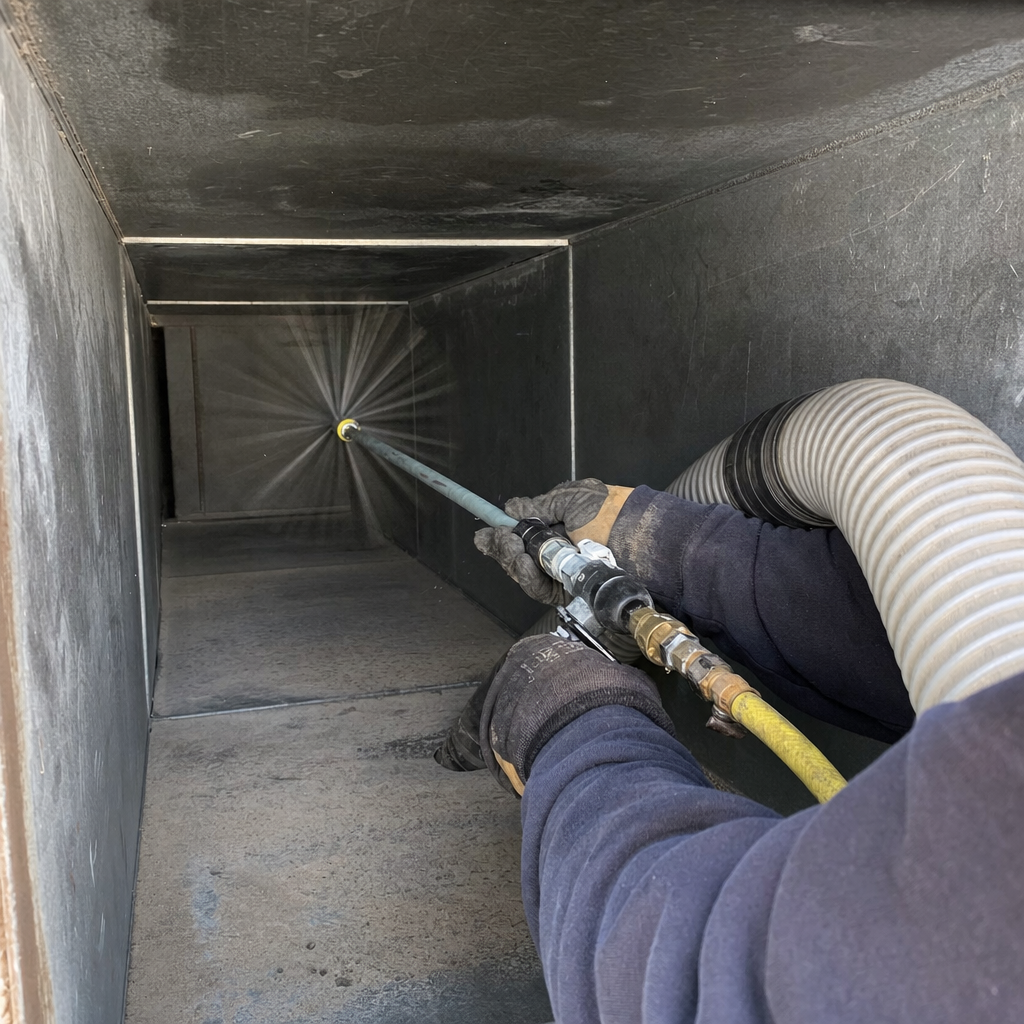
Agitation tools: Compressed air whips, rotary brushes, or cable-driven systems dislodge debris so the negative air machine can extract it. The tool must match the duct material — aggressive brushes damage flexible ductwork common in post-1980s New York City construction.
HEPA filtration: Exhaust air from the cleaning process must be filtered to 0.3 microns. Unfiltered exhaust simply relocates your contamination to the building hallway or adjacent apartment — a genuine concern in New York City’s dense housing stock.
Inspection tools: Remote video systems or proper borescope cameras allow pre- and post-cleaning documentation. We integrate with Honeywell and Aprilaire air quality monitoring systems where installed, so you can verify improvement through data, not just our word.
Contractor-grade equipment most residential crews never carry makes a measurable difference in results. We’ve been called to re-clean after budget operators who used inadequate suction left significant debris behind — visible on camera, verifiable by any subsequent contractor.
Your Post-Job Verification Checklist
Before you finalize payment, confirm these items. A legitimate contractor will not rush you past this stage.
- Verify negative pressure was maintained. Ask to see the negative air machine running with the duct access panel open — you should feel strong suction. If the machine was turned off “to save noise” during cleaning, the containment failed.
- Inspect access panels. Every access point created for cleaning should be properly sealed with mechanical fasteners, not tape alone. Metal ducts in New York City’s older buildings particularly need screw-secured patches that won’t loosen from vibration.
- Review photo or video documentation. Before-and-after images of key duct sections should be available. If the contractor claims they “don’t do photos,” that’s a red flag in 2025.
- Check system operation. The HVAC system should run normally with no unusual noise, vibration, or airflow reduction. Cleaning should improve performance, not degrade it.
- Confirm filter status. If your system includes a media filter or electronic air cleaner, verify it wasn’t damaged or bypassed during cleaning. We service Guardsman and other integrated air quality systems as part of our standard scope.
- Receive written documentation. A completion report noting what was cleaned, equipment used, and any conditions observed (damaged ductwork, asbestos, etc.) protects both parties.
From cleaning to repair to sanitizing — one call closes the loop on your air quality. If your contractor discovered issues requiring follow-up, you shouldn’t need a second contractor to finish the job.
Common Mistakes to Avoid
- Booking based on price alone. In New York City’s market, the lowest quote is statistically the most likely to involve upsell fraud. The Attorney General’s complaint data confirms this pattern year after year.
- Accepting phone quotes without site assessment. A contractor who can quote accurately without knowing your building’s duct configuration, access conditions, and system type is either guessing or planning to change the price on arrival.
- Ignoring building-specific factors. Pre-war buildings, post-war concrete construction, and new developments each present distinct challenges. A contractor who treats a Park Slope brownstone the same as a Midtown high-rise hasn’t looked at your system.
- Skipping the NADCA verification step. Logo theft is common. Verify membership independently, then ask the follow-up questions about ACR standards.
- Paying in full before verification. No legitimate contractor demands full payment before you can inspect the work. Standard practice is payment on satisfactory completion.
- Hiring a generalist for specialist work. HVAC companies that “also do” duct cleaning often lack the dedicated equipment and focused training. Two decades of duct work, not generalist HVAC services, produces different results.
- Neglecting dryer vent inspection. In New York City’s multi-unit buildings, dryer vent blockages are common and dangerous. If you’re addressing air quality, include Dryer Vent Cleaning in Buffalo and your local area in the scope.
When to Call a Professional
Schedule professional air duct cleaning when you notice visible dust emission from supply registers, persistent odors that don’t source to a specific cause, uneven heating or cooling suggesting blockage, or after any renovation generating construction dust. In New York City’s climate — humid summers that promote microbial growth, heating-season particulate accumulation, and pollen seasons that load filters — we recommend assessment every three to five years for typical residential systems, more frequently for buildings with pets, smokers, or recent construction.
Landmark Air Duct Cleaning Service New York offers free estimates in New York City — call (833) 754-6107. Richard Anderson will assess your system personally, specify exactly what your building needs, and provide a written quote with no obligation. For our Air Duct Cleaning in Buffalo and HVAC Cleaning in Buffalo service areas, we maintain the same owner-operator standard.
Frequently Asked Questions
Residential air duct cleaning in New York City typically costs $400–$900 for a standard single-family or apartment system, with prices scaling for larger homes, multi-unit buildings, or commercial spaces. Factors affecting price include duct accessibility, contamination level, system size, and whether additional services like dryer vent cleaning or sanitizing are included. Call (833) 754-6107 for an exact quote — estimates are free.
A legitimate quote specifies equipment type, lists every duct component to be cleaned with line-item pricing, includes access panel creation and sealing, and guarantees the total price with no “additional services may be required” escape clauses. Vague language, flat rates without assessment, and on-site upsell pressure are universal indicators of bait-and-switch operations. Always get three quotes and apply the phone intake test described above.
No — NADCA membership confirms a company has met basic requirements, but active adherence to ACR standards requires specific practices you can verify. Ask about their pre-cleaning assessment checklist, negative air machine CFM rating, and post-cleaning documentation protocol. A member who cannot answer these questions has the certification without the practice.
Professional cleaning can reduce airborne allergen load when ducts contain accumulated dust, pollen, pet dander, or microbial contamination — common in New York City’s older buildings with decades of accumulation. It is not a medical treatment, and results vary with individual sensitivity and the specific contaminants present. We assess allergen-related concerns during our initial consultation and can integrate with existing Honeywell or Aprilaire air quality systems where installed.
A thorough residential cleaning typically requires 3–5 hours for a standard system, with larger homes or heavily contaminated systems taking longer. Beware of contractors who promise completion in under two hours — adequate negative air setup, proper agitation, and post-cleaning verification cannot be rushed. In New York City’s dense building environment, setup and containment add time that rushed operators skip.
Yes — post-construction duct cleaning is essential in New York City, where renovation dust contains drywall compound, insulation particles, and potentially hazardous materials from older buildings. Construction dust is fine enough to penetrate standard filters and accumulate in ductwork, continuing to circulate long after visible cleanup is complete. We recommend scheduling cleaning after final construction cleanup but before occupying renovated spaces.
The Bottom Line
Hiring an air duct cleaning contractor in New York City is a vetting problem, not a shopping problem. The market rewards operators who exploit information gaps with low introductory prices and high-pressure upsells. Your protection is specific knowledge: the phone intake questions that reveal call-center operations, the quote line items that expose vague scopes, the equipment specifications that distinguish professionals from pretenders, and the post-job verification that confirms you received what you paid for. Apply the three-call test, verify NADCA membership independently, demand written equipment specifications, and never pay before inspecting completed work. The legitimate specialists — owner-operators with documented equipment, transparent quotes, and personal accountability — are findable once you know what to ask.
Written by Richard Anderson, Owner & Lead Technician at Landmark Air Duct Cleaning Service New York, serving New York City since 2006.