
Last updated July 10, 2026
The Complete Guide to Air Duct Cleaning in New York City
Here’s something most duct cleaning companies in New York City won’t tell you upfront: the majority of pre-war buildings in Manhattan, Brooklyn, and Queens were never designed for forced-air systems. They were built for steam radiators, then retrofitted decades later with ductwork crammed into dropped ceilings, chases, and walls that were never meant to carry air. That means a standard truck-mounted negative air machine — the kind that works fine in a suburban ranch house — often can’t even get into your building, let alone do a proper job. In two decades of crawling through New York City duct systems, we’ve learned that effective cleaning here requires equipment choices and techniques that most franchise crews simply don’t bring to the job.
Quick Answer
Professional air duct cleaning in New York City typically costs $400–$900 for a standard residential system, takes 3–5 hours, and should include a pre-cleaning camera inspection, source removal with either truck-mounted or portable negative air equipment, and a post-cleaning verification. In New York City’s older building stock, proper cleaning requires specialized portable equipment and technician experience with non-standard duct runs that most companies won’t mention until they’re on-site.
Table of Contents
- Why NYC Buildings Are Different: Pre-War Stock and Retrofit Ductwork
- What NADCA Standards Actually Mean — And What Most Companies Deliver
- Equipment Matters: Truck-Mounted vs. Portable Negative Air in NYC
- Urban Particulate: What NYC Dust Actually Contains
- The Cleaning Process Step by Step
- Red Flags: How to Spot an NYC Duct Cleaning Scam
- What It Costs in New York City — And What’s Included
- Maintenance Between Professional Cleanings
Why NYC Buildings Are Different: Pre-War Stock and Retrofit Ductwork
Walk into a Park Slope brownstone built in 1890, a Washington Heights pre-war co-op from 1925, or a Jackson Heights garden apartment from 1940, and you’re looking at structures that predate residential forced-air systems by decades. These buildings were designed for coal, then oil, then steam heat. When central air conditioning arrived — often in the 1960s through 1980s — contractors improvised.
We’ve seen the results in hundreds of New York City jobs:
- Flexible duct jammed into plaster chases with no access panels, making proper cleaning impossible without cutting drywall
- Dropped ceilings hiding a maze of sagging flex duct with multiple 90-degree turns that trap debris
- Supply and return runs sharing the same unlined wall cavities — a code violation by modern standards but grandfathered in
- Ductwork sized for 1950s airflow expectations, now straining under modern HVAC loads and accumulating condensation that breeds microbial growth
- No central return — just multiple “jump ducts” between rooms that bypass filtration entirely
In Astoria, we regularly find 1960s-era flexible duct that’s become brittle and collapsed in sections. In the Upper West Side, we’ve encountered original galvanized duct from 1970s conversions that’s rusted through at the seams. In Harlem, we’ve seen beautiful historic plasterwork destroyed by careless contractors who didn’t understand how to access retrofit ductwork without demolition.
The practical implication: a technician who treats your New York City system like a standard suburban installation will either do damage or do an incomplete job. Richard Anderson — owner and lead technician — handles every Landmark job personally, and the first thing he assesses is whether the ductwork configuration even allows for full cleaning access.
What NADCA Standards Actually Mean — And What Most Companies Deliver
NADCA (the National Air Duct Cleaners Association) publishes the ACR standard — Assessment, Cleaning, and Restoration of HVAC Systems. It’s the only recognized industry standard, and any legitimate company should follow it. Here’s what it actually requires versus what we see happening in New York City:
| ACR Standard Requirement | What We Often See in NYC |
|---|---|
| Pre-cleaning inspection with access to all system components | Phone quotes without seeing the building; no camera inspection |
| Source removal using mechanical agitation and negative air collection | Shop vacs or compressed air blowers without containment |
| Protection of building and furnishings during cleaning | No floor protection, no corner guards, no containment of work areas |
| Post-cleaning verification and customer documentation | “Trust us, it’s clean” — no photos, no measurements |
| Cleaning of all components: supply, return, trunk lines, registers, grilles | Only visible register cleaning, trunk lines skipped |
The ACR standard also specifies that cleaning should not damage the HVAC system or building — which sounds obvious until you’ve seen a contractor rip a register out of 100-year-old plaster because they didn’t know how to remove it properly.
Here’s the reality: NADCA membership is voluntary, and in New York City’s high-pressure market, many companies advertise “NADCA-certified” while their actual technicians have never read the standard. Ask specifically: Will you do a pre-cleaning camera inspection? Will you show me post-cleaning verification? Will you protect my floors and walls? If they hesitate or deflect, you’re not getting ACR-standard work.
Equipment Matters: Truck-Mounted vs. Portable Negative Air in NYC
This is where most New York City duct cleaning guides fail completely. They describe ideal equipment without acknowledging the physical constraints of urban buildings.
Truck-mounted negative air machines are the gold standard for power and airflow. They generate 5,000+ CFM of suction, run on dedicated power, and maintain consistent performance for hours. In a suburban home with a driveway and basement utility room, they’re unbeatable.
In New York City? We’ve been on jobs where the “truck-mounted” company showed up with a van that couldn’t legally park within three blocks of the building. Where their hoses needed to run through a lobby, up a service elevator, down a hallway, and into a unit — 200 feet of hose that reduced their effective suction by 60%. Where the building’s electrical system couldn’t handle their power draw without tripping breakers shared with neighbors.
Portable negative air machines — units from manufacturers like Nikro and Abatement Technologies that we bring into buildings — are specifically designed for these constraints. They’re HEPA-filtered, powerful enough for residential and light commercial systems, and can be carried into elevators, up stairs, and through standard doorways. In our 20 years of New York City work, portables handle roughly 80% of residential jobs more effectively than truck-mounted systems would, simply because they can be positioned optimally within the building.
The key differentiator isn’t the equipment category — it’s whether the technician understands which tool suits your specific building. A company that only owns truck-mounted equipment will use it regardless of fit. A company that only owns cheap portables won’t have the power for larger systems. At Landmark Air Duct Cleaning Service New York home, we carry both Rotobrush portable systems and Nikro negative air units, and Richard Anderson selects based on your building’s access, not his inventory’s convenience.
Urban Particulate: What NYC Dust Actually Contains
Suburban duct cleaning guides talk about pollen, pet dander, and ordinary household dust. New York City’s air contains all of those, plus a cocktail that’s genuinely different:
- Diesel particulate matter (DPM) from truck traffic, buses, and construction equipment — ultrafine particles that penetrate standard filtration and accumulate in ductwork as black, oily residue
- Subway particulate in buildings near lines — iron oxide, brake dust, and carbon that creates distinctive reddish-black deposits
- Construction dust from the perpetual cycle of renovation in New York City buildings — gypsum, silica, and joint compound that cakes in returns during neighbors’ projects
- High-rise facade and window seal degradation — older buildings leak outdoor air through failed gaskets, bypassing filters entirely
- Humidity-driven microbial growth from steam system conversions that left oversized equipment cycling inefficiently
In our experience, New York City duct systems accumulate debris 30–50% faster than comparable suburban systems, simply due to outdoor air infiltration and urban particulate load. We’ve cleaned ducts in Tribeca lofts where the returns were coated in black diesel soot from Holland Tunnel traffic. We’ve found subway brake dust in Midtown apartments a full floor above ground level. We’ve seen construction dust from a neighbor’s renovation migrate through shared building chases and completely clog a system in Greenwich Village.
The inspection signs are specific: black, oily residue on return grilles (diesel); reddish powder near lower floors (subway iron oxide); white, chalky buildup (construction gypsum); musty, sweet odor combined with dark spotting (microbial growth from humidity cycling). When Richard Anderson inspects your system, he’s looking for these New York City-specific signatures to determine not just how to clean, but what protective measures your building needs going forward.
The Cleaning Process Step by Step
A proper duct cleaning in New York City follows a sequence that protects your building, your system, and your air quality. Here’s how we execute every job:
Step 1: Pre-Cleaning Inspection and Documentation
We access every component we can reach — registers, grilles, trunk lines where accessible, filter locations, and the air handler. We run a camera through main trunk lines to document pre-cleaning condition. In New York City’s older buildings, this step often reveals access problems that change our approach: collapsed flex duct, disconnected runs, or asbestos-wrapped pipes that require modified procedures.
Step 2: Building Protection
We lay protective covering on floors and stairs, install corner guards, and seal off work areas from living spaces. In high-rise buildings, we protect common areas and elevator lobbies. We bring HEPA air scrubbers for jobs with significant debris or microbial concerns.
Step 3: System Access Creation
We cut access ports in trunk lines where needed — always at proper locations, always sealed properly afterward. In retrofit ductwork, we sometimes need to create temporary access through dropped ceiling panels, which we restore.
Step 4: Source Removal with Mechanical Agitation
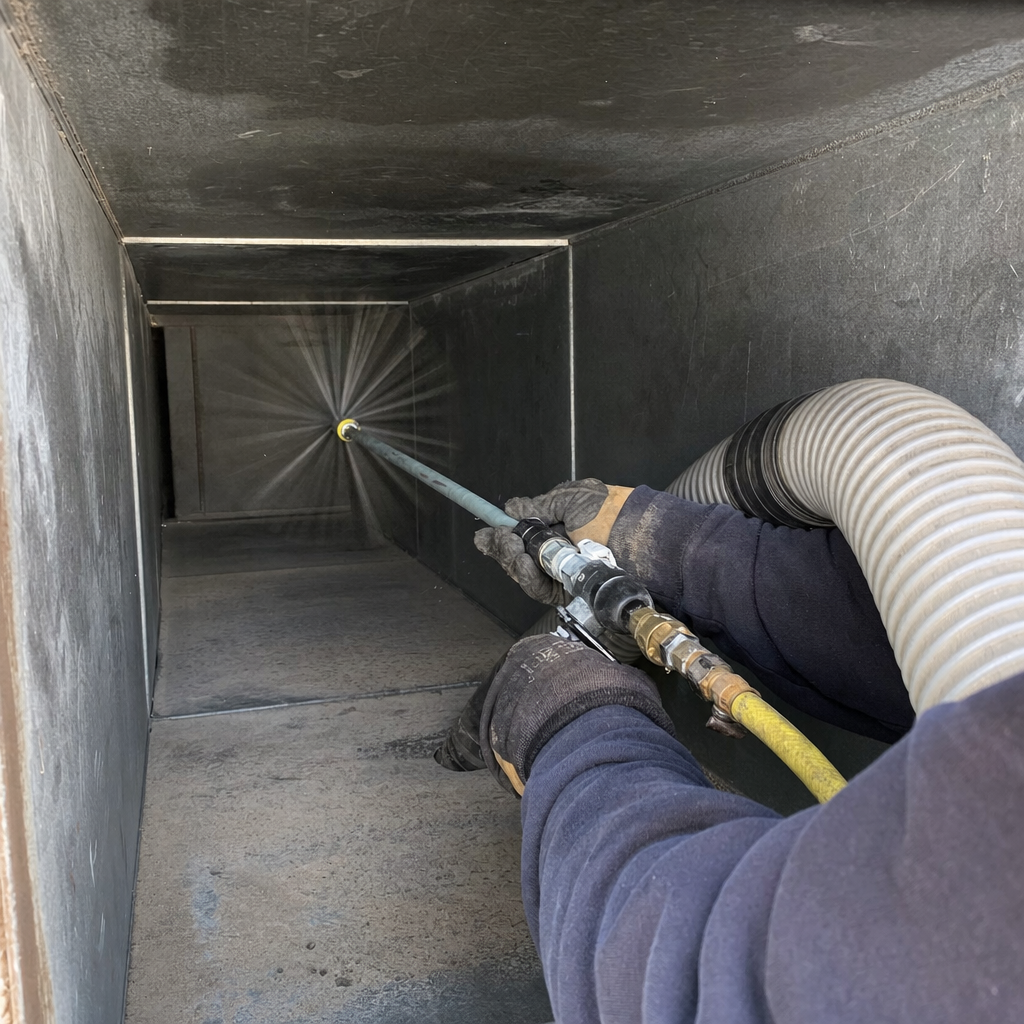
We use Rotobrush contact cleaning for duct interiors — rotating brushes that loosen adhered debris while simultaneous vacuum extraction captures it. For larger commercial systems or heavy buildup, we deploy Nikro or Abatement Technologies portable negative air machines with compressed air whips and skipper balls that navigate non-standard duct configurations.
Step 5: Component Cleaning
Registers, grilles, diffusers, and accessible air handler components are cleaned and sanitized. We inspect and replace filters if provided by the customer. For buildings with Honeywell, Aprilaire, or Guardsman air quality systems, we verify integration and condition.
Step 6: Post-Cleaning Verification
We re-run camera inspection through cleaned lines, photograph results, and provide documentation. We test system airflow and operation. We walk the customer through findings and show before/after documentation.
Step 7: Sealing and Restoration
All access ports are sealed with proper materials. Protective coverings are removed. We leave the work area cleaner than we found it — a standard we enforce because Richard Anderson is the person doing the work, not a rotating crew with no personal stake in your satisfaction.
Red Flags: How to Spot an NYC Duct Cleaning Scam
New York City’s density and transient population make it fertile ground for duct cleaning scams. Here are the specific warning signs we’ve encountered:
- Phone quotes without inspection. No legitimate company can price a job accurately without seeing your building’s access, duct configuration, and system condition. Anyone quoting $99 or $149 over the phone is planning to upsell or do superficial work.
- No pre-cleaning camera inspection. If they won’t show you what’s in your ducts before cleaning, they don’t want you to hold them accountable for results.
- “Whole house special” pricing. In New York City, a “whole house” might be a 600-square-foot studio or a 4,000-square-foot brownstone. Flat pricing without assessment is either a bait-and-switch or a guarantee of rushed, incomplete work.
- Unable to explain equipment for your building. Ask specifically: “How will you get your equipment into this building?” If they mention truck-mounted systems without asking about parking, elevator access, or electrical capacity, they haven’t thought through your job.
- High-pressure sanitizing upsells. Legitimate sanitizing has its place, but it’s often pushed as a high-margin add-on after the “basic” cleaning proves inadequate. Proper source removal should be the foundation; sanitizing addresses what’s left.
- No local address or verifiable reviews. Check their review count and distribution. A handful of perfect reviews spread across years suggests fake profiles. 548 reviews averaging 4.9 stars — our actual record — reflects consistent performance you can verify.
- Cash-only or pressure to decide immediately. Professional companies in New York City accept standard payment methods and give you time to consider your options.
What It Costs in New York City — And What’s Included
Based on our 20 years of pricing jobs across New York City’s neighborhoods, here’s what professional duct cleaning actually costs:
| System Type | Typical Range | Factors Affecting Price |
|---|---|---|
| Studio / 1-bedroom apartment | $350–$550 | Access difficulty, number of registers, presence of asbestos wrapping |
| 2–3 bedroom apartment / condo | $500–$800 | Building elevator access, parking for equipment, system complexity |
| Townhouse / brownstone (single unit) | $700–$1,200 | Multiple floors, non-standard duct runs, historical preservation requirements |
| Small commercial (retail, restaurant, office) | $800–$1,500 | After-hours scheduling, grease or specialized debris, code compliance documentation |
What’s included in legitimate pricing: pre-cleaning inspection with camera documentation, full source removal cleaning of all accessible components, post-cleaning verification, proper building protection, and disposal of all debris. What’s often excluded by low bidders: trunk line cleaning, air handler access, proper sealing of access ports, and protection of your finishes.
For properties in Air Duct Cleaning in Buffalo or surrounding upstate areas, pricing reflects different building stock and access patterns — though the same standards apply.
Maintenance Between Professional Cleanings
Professional cleaning every 3–5 years is standard for New York City residential systems, with shorter intervals for buildings near heavy construction, major transit lines, or with allergy-sensitive occupants. Between professional services:
- Change filters on schedule — monthly for standard 1-inch filters in high-particulate environments, every 2–3 months for pleated media filters. In New York City, we see filters load faster than manufacturer estimates due to urban air quality.
- Inspect visible registers quarterly for black buildup, moisture staining, or musty odors — early indicators of problems that need professional attention.
- Keep outdoor air intakes clear of debris, and verify that window and door seals are intact to reduce unfiltered infiltration.
- Run bathroom and kitchen exhaust fans during moisture-generating activities to reduce humidity load on the HVAC system.
- Schedule dryer vent cleaning annually — a separate but related service that reduces fire risk and improves overall system efficiency. We offer this alongside duct cleaning; see Dryer Vent Cleaning in Buffalo for our regional service details, or contact us directly for New York City scheduling.
For comprehensive HVAC system maintenance including coil cleaning and component inspection, our HVAC Cleaning in Buffalo page outlines our full-scope approach, which we apply throughout our New York City service area as well.
Common Mistakes to Avoid
- Hiring based on lowest price alone. In New York City’s high-cost market, a bid significantly below competitors typically means skipped steps, uninsured workers, or equipment that can’t do the job properly. The cost of fixing damage from improper cleaning exceeds any initial savings.
- Ignoring building-specific access challenges. Don’t assume any company can handle your pre-war brownstone or high-rise co-op. Ask specifically about their experience with your building type.
- Skipping post-renovation cleaning. Construction dust from even minor renovations migrates into duct systems and circulates for years. We see this constantly in New York City’s renovation-heavy market.
- Using the wrong filter type. High-MERV filters in undersized systems restrict airflow and damage equipment. We assess your system’s capacity before recommending filtration upgrades.
- Neglecting dryer vents. Clogged dryer vents are a leading cause of residential fires and force your HVAC system to work harder. Annual cleaning is essential.
- Attempting DIY duct cleaning. Household vacuums lack the suction and containment for ductwork, and without proper agitation tools, you’ll dislodge debris that then circulates through your home. Worse, damaging ductwork in New York City’s retrofit systems often requires expensive access reconstruction.
- Assuming “sanitizing” replaces cleaning. Chemical treatments without proper source removal seal debris in place. NADCA specifically cautions against this approach.
When to Call a Professional
Call for professional assessment if you notice visible dust emission from registers, persistent musty odors when the system runs, uneven heating or cooling, increased allergy symptoms indoors, or if it’s been more than five years since your last cleaning. After any renovation — even in adjacent units — schedule inspection, as construction dust migrates through shared building systems in ways unique to New York City’s dense construction.
Landmark Air Duct Cleaning Service New York offers free estimates in New York City — call (833) 754-6107. Richard Anderson handles every assessment personally, and you’ll speak directly with the technician who would perform your work, not a sales representative reading from a script.
Frequently Asked Questions
Residential duct cleaning in New York City typically ranges from $350 for a studio apartment to $1,200 for a multi-floor brownstone, with most 2–3 bedroom apartments falling between $500–$800. The specific price depends on your building’s access, duct configuration, and system condition — which is why we don’t quote over the phone without seeing your space. Call (833) 754-6107 for a free, no-obligation estimate.
Every 3–5 years for standard residential systems, but urban factors often justify shorter intervals. Buildings near major construction, elevated transit lines, or high-traffic corridors accumulate debris faster. We’ve recommended 2-year intervals for ground-floor units in Midtown with significant diesel exposure, and annual inspection for properties with ongoing renovation in the building.
Yes, when done properly as part of broader indoor air quality management. Source removal cleaning reduces circulating allergen load — pollen, dust mite debris, pet dander, and mold spores. However, cleaning alone won’t solve problems caused by ongoing moisture intrusion, inadequate filtration, or outdoor air infiltration. We assess these contributing factors during our inspection and can integrate Honeywell or Aprilaire air quality systems where appropriate.
The industry has legitimate practitioners and outright frauds. Legitimate cleaning follows NADCA’s ACR standard: inspection, source removal with proper equipment, verification, and documentation. Scams involve phone solicitations with too-good-to-be-true pricing, no inspection, shop-vac “cleaning,” and high-pressure upsells. In 20 years, we’ve repaired damage from incompetent competitors and documented conditions that previous “cleanings” missed entirely.
A thorough residential job in New York City takes 3–5 hours for a standard apartment, 5–8 hours for a townhouse or brownstone. Rushed jobs — the “in-and-out in 90 minutes” specials — skip trunk lines, miss returns, or fail to protect your space properly. Our timeline reflects proper access, complete component cleaning, and verification documentation.
Improper cleaning can damage plaster, dislodge historic finishes, or collapse deteriorated flex duct. This risk is highest in New York City’s pre-war stock with retrofit ductwork. Proper technique — including appropriate agitation intensity, proper access creation, and building protection — prevents damage. Richard Anderson’s 20 years of New York City-specific experience means he’s encountered and solved these challenges before reaching your home.
The Bottom Line
Air duct cleaning in New York City isn’t a commodity service — it’s a specialized trade that requires equipment choices and technical knowledge matched to the city’s unique building stock. Pre-war retrofit ductwork, urban particulate loads, and high-rise access constraints make generic approaches ineffective or actively harmful. The technician who inspects your system, selects appropriate equipment, and protects your building during work determines whether you receive genuine value or an expensive disappointment.
Look for pre-cleaning camera inspection, specific equipment suited to your building’s access, verifiable reviews from substantial customer volume, and direct accountability from the person doing the work. In a market saturated with franchise crews and phone-book specials, these distinctions separate legitimate specialists from opportunists.
Written by Richard Anderson, Owner & Lead Technician at Landmark Air Duct Cleaning Service New York, serving New York City since 2006.