
Last updated July 10, 2026
Air Duct Cleaning Maintenance Checklist for New York City Homeowners
The single maintenance task that prevents 80% of the between-cleaning buildup I see in New York City homes costs nothing and takes three minutes — but it’s never on any checklist because it doesn’t sell products. It’s simply running your kitchen and bathroom exhaust fans for ten minutes after cooking or showering, every single time. In twenty years of crawling through ductwork across Manhattan, Brooklyn, Queens, and the Bronx, I’ve learned that most “maintenance” advice is written by people who’ve never removed a register cover. This guide is different. It’s built from what Richard Anderson — owner and lead technician at Landmark Air Duct Cleaning Service New York home — actually checks during repeat-client walkthroughs, calibrated to the specific stresses that New York City’s climate, construction patterns, and air quality place on residential duct systems.
Quick Answer
A proper air duct cleaning maintenance checklist for New York City homeowners includes monthly filter checks, quarterly visual inspections of accessible vents, seasonal pre-startup reviews before heating and cooling seasons, and professional cleaning every 3–5 years — more frequently if you’ve renovated, have pets, or live near major construction corridors. The critical difference in New York City is adjusting intervals based on actual local air quality, seasonal construction dust, and the higher particulate load from urban density, not manufacturer guidelines written for suburban markets.
Table of Contents
- The Monthly Rhythm: What to Check Every 30 Days
- Season-by-Season Checklist for NYC’s Climate Triggers
- How to Do a Legitimate DIY Visual Inspection
- Filter Change Intervals: NYC Air Quality Reality vs. Manufacturer Boilerplate
- The Dryer Duct Danger Most Homeowners Ignore
- Document Everything: Building Leverage Before You Call a Contractor
- Common Mistakes to Avoid
- When to Call a Professional
- Frequently Asked Questions
The Monthly Rhythm: What to Check Every 30 Days
Most homeowners treat filter replacement like an oil change — wait for a reminder, then scramble. In New York City, that’s a costly mistake. Our PM2.5 levels routinely exceed EPA guidelines, especially during summer ozone season and winter thermal inversion events. A filter that should last three months in Buffalo might be saturated in six weeks in Midtown.
Here’s what we check monthly on our own properties and recommend to every client:
- Filter visual inspection: Hold it to a window. If you can’t see light through it clearly, it’s done. Don’t wait for the printed date.
- Register and return grille check: Look for dust accumulation on the slats themselves — this indicates the filter has been bypassing particulate for days or weeks.
- Listen to your system: New whistling or humming from supply vents often means a clogged filter is creating pressure differentials that pull debris past the filter frame.
- Check the condensate drain pan (cooling season): Standing water means microbial growth, which means spores entering your distribution system. In humid New York City summers, this accelerates fast.
- Run the bathroom exhaust: Hold a tissue against the grille. Weak suction means the duct is clogged with lint and moisture residue — a mold risk in our humid climate.
The five-minute monthly check prevents the kind of layered buildup that turns a standard cleaning into a remediation job. We’ve seen $200 maintenance calls become $1,200 restorations because a homeowner ignored whistling vents for three seasons.
Season-by-Season Checklist for NYC’s Climate Triggers
New York City’s seasons hit ductwork differently than anywhere else I’ve worked. The construction calendar, heating oil patterns, and holiday cooking loads create specific stress points that generic checklists miss entirely.
Spring (March–May): Construction Season Dust Infiltration
Street-level construction kicks into gear when frost laws lift. In neighborhoods like the Lower East Side, Long Island City, and Gowanus, where renovation and new development are constant, fine concrete and drywall dust infiltrates through window seals and gets drawn into return air pathways.
- Inspect window and door seals near return grilles
- Check outdoor condenser coils for construction debris if you have central AC
- Consider upgrading to a MERV-11 filter during heavy construction periods
- Schedule professional cleaning if you’ve had windows open during nearby demolition
Summer (June–August): Humidity and Ozone Load
New York City’s summer air quality index regularly hits “Unhealthy for Sensitive Groups.” Combine that with 70%+ humidity and you’ve got ideal conditions for microbial growth inside ductwork, especially in pre-war buildings with uninsulated basement trunk lines.
- Verify condensate drainage is clear and flowing
- Check for musty odors when AC first cycles on — this indicates evaporator mold
- Inspect flex duct connections in attics or crawl spaces for condensation staining
- Run dehumidification if your system includes it; standalone units near returns help
Fall (September–October): Heating Startup Debris
This is the highest-risk season for service calls. After six months of disuse, heating systems start up with accumulated dust, rodent droppings, and — in oil-heated buildings — soot particles from last season’s combustion. October 15–November 1 is our busiest call period every year.
- Replace filter before first heating cycle, not after
- Run system for 30 minutes with windows open to purge initial burn-off
- Check for visible soot around supply registers — indicates heat exchanger issues requiring immediate HVAC service
- Inspect carbon monoxide detectors; duct leaks can backdraft combustion gases
Winter (November–February): Holiday Cooking Grease and Thermal Stress
Thanksgiving through New Year’s is the highest grease-load period for kitchen exhaust systems in New York City. Many apartments have recirculating range hoods that dump cooking particulate right back into the living space, where it gets drawn into return air grilles.
- Clean range hood filters monthly during heavy cooking periods
- Wipe down kitchen supply register slats — grease film is a dust magnet
- Check for cold spots near ducts running through unheated spaces; insulation gaps cause condensation in winter
- Monitor for ice damming on rooftop exhausts in walk-up buildings
How to Do a Legitimate DIY Visual Inspection
I’m going to show you exactly what I look for when a homeowner sends me photos before a visit. This isn’t about selling you a scope inspection — it’s about knowing when you need professional help versus when you’re looking at normal accumulation.
What You’ll Need
- Phone flashlight (not the screen — the actual LED)
- A clean microfiber cloth
- A standard screwdriver for register removal
- Your phone camera
Step-by-Step Inspection Process
- Turn off your HVAC system. Running airflow disturbs loose debris and gives false impressions.
- Remove a supply register. Choose one in a high-traffic room and one in a bedroom — they tell different stories.
- Shine light straight down the duct. Look for the first 3–4 feet, which is what phone cameras can capture.
- Wipe the duct wall with your cloth. Light gray dust is normal. Dark, greasy residue or visible clumps indicate filtration failure or kitchen grease infiltration.
- Photograph everything. Date-stamped documentation is your leverage.
Normal vs. Concerning: What the Photos Should Show
| Normal Findings | Concerning Findings |
|---|---|
| Thin, even layer of gray dust on duct walls | Thick, fuzzy buildup more than 1/8 inch deep |
| Occasional hair or fiber on register fins | Visible mold growth (black, green, or white patches) |
| Slight discoloration at duct joints | Dark staining indicating moisture intrusion |
| Clean metal visible between dust particles | Construction debris (drywall chunks, wood splinters) |
| Uniform dust color throughout | Odor of mildew, sewage, or heating oil when system runs |
In pre-war New York City buildings, especially in Washington Heights, Inwood, and parts of Brooklyn with original plaster construction, expect more dust load from aging wall materials. That’s normal. What isn’t normal is seeing the same debris pattern after you’ve changed filters religiously — that indicates duct leakage pulling from wall cavities or between floors.
Filter Change Intervals: NYC Air Quality Reality vs. Manufacturer Boilerplate
Filter packaging that claims “90-day life” is tested in clean-room conditions, not on a third-floor walk-up facing Second Avenue bus traffic. Here’s what two decades of field data tells us about actual New York City filter performance.
The EPA’s AirNow data shows New York City’s annual PM2.5 averages run 20–40% higher than upstate regions. That doesn’t sound dramatic until you realize filters work on an exponential loading curve — they don’t clog linearly. Once a filter reaches about 50% capacity, pressure drop increases rapidly and bypass begins around the frame edges.
Adjusted Filter Schedules for NYC Conditions
| Filter Type | Manufacturer Claim | NYC Urban Reality | NYC Near Major Construction |
|---|---|---|---|
| Basic fiberglass (MERV 1–4) | 30 days | 20–25 days | 14–18 days |
| Pleated MERV 8 | 90 days | 45–60 days | 30–45 days |
| Pleated MERV 11 | 90 days | 60–75 days | 45–60 days |
| HEPA-type (MERV 13+) | 6–12 months | 3–4 months | 2–3 months |
We install and service Honeywell and Aprilaire air quality systems, and the homeowners who get the longest filter life are the ones who run their systems on “circulate” mode during high-AQI days — keeping air moving through the filter even when heating or cooling isn’t called for. It’s a simple setting change that extends filter life 20–30%.
One critical note: higher MERV isn’t always better. In older New York City buildings with original ductwork and undersized returns, a MERV-13 can create enough pressure drop to strain the blower motor and actually increase leakage from duct seams. We assess this during every HVAC Cleaning in Buffalo and New York City visit — the physics are identical, though building ages differ.
The Dryer Duct Danger Most Homeowners Ignore
Between full air duct cleanings, your dryer vent is the single highest fire-risk item in your home’s air distribution network. The U.S. Fire Administration identifies dryer lint as a leading cause of residential fires, and New York City’s dense housing — with longer duct runs, shared venting in co-ops, and rooftop terminations that freeze — amplifies the risk.
Here’s what to check between professional cleanings:
- Drying time: If a standard load takes more than 55 minutes, airflow is restricted. Period.
- Exterior flap movement: The vent hood should snap open forcefully when the dryer runs. Weak movement means blockage.
- Lint behind the dryer: Any accumulation on the floor indicates a disconnected or leaking transition duct.
- Burning smell: This is an emergency stop — call a professional before running the dryer again.
In high-rise buildings, especially post-war towers on the Upper East Side and in Battery Park City, dryer ducts often run 20–30 feet with multiple elbows before reaching a rooftop termination. These configurations require annual inspection at minimum — the friction loss accelerates lint deposition exponentially with every turn.
We handle Dryer Vent Cleaning in Buffalo and throughout New York City with Rotobrush and Nikro equipment designed for these extended runs. If your building’s duct exceeds 25 feet or has more than two 90-degree turns, assume it needs annual attention regardless of what your board’s maintenance schedule says.
Document Everything: Building Leverage Before You Call a Contractor
The homeowners who get the best outcomes from professional service are the ones who walk in with data, not complaints. After two decades of fielding “it smells weird” calls that turn into three-hour diagnostic hunts, I can tell you: documentation saves you money and gets you accurate answers faster.
What to Record and When
- Filter changes: Date, brand, MERV rating, and a photo of the used filter. This establishes your maintenance baseline.
- Visual inspection photos: Date-stamped images from the same register locations, quarterly. Trend data beats single snapshots.
- System performance notes: Unusual noises, odors, temperature variations room-to-room, and when they started.
- Any construction or renovation: Dates, scope, and whether HVAC was sealed during work. Post-renovation cleanings are non-negotiable — drywall dust is abrasive to blower motors and sets permanent residue in flex duct.
- Professional service records: What was done, equipment used, before/after photos if provided.
When you call Landmark Air Duct Cleaning Service New York with this information, Richard Anderson — owner and lead technician — can scope the job accurately before arriving, bring the right equipment (whether that’s Rotobrush contact cleaning for residential trunk lines or Abatement Technologies HEPA containment for post-remediation work), and give you a firm estimate rather than a range that balloons on-site.
The alternative is what we see too often: a homeowner with three years of vague symptoms gets a $99 “whole house special” from a franchise crew that spends 45 minutes with a shop vac and leaves the problem intact. Two decades of duct work, not generalist HVAC services, teaches you that proper diagnosis precedes proper treatment.
Common Mistakes to Avoid
- Using the “cheapest filter that fits.” In New York City’s particulate environment, a $3 fiberglass filter costs you more in accelerated blower wear and duct contamination than a $12 pleated unit saves upfront. The math reverses within 18 months.
- Blocking supply vents in unused rooms. This seems logical but creates pressure imbalances that pull unfiltered air from wall cavities, basements, and — in multi-family buildings — neighboring units. We’ve found rodent droppings and construction debris in ducts traced directly to this practice.
- Ignoring the return air pathway. Homeowners obsess over supply vents (where air comes out) but returns (where it goes in) collect far more debris because they’re unfiltered intake points. The return grille and the first few feet of duct behind it are usually the dirtiest section of the system.
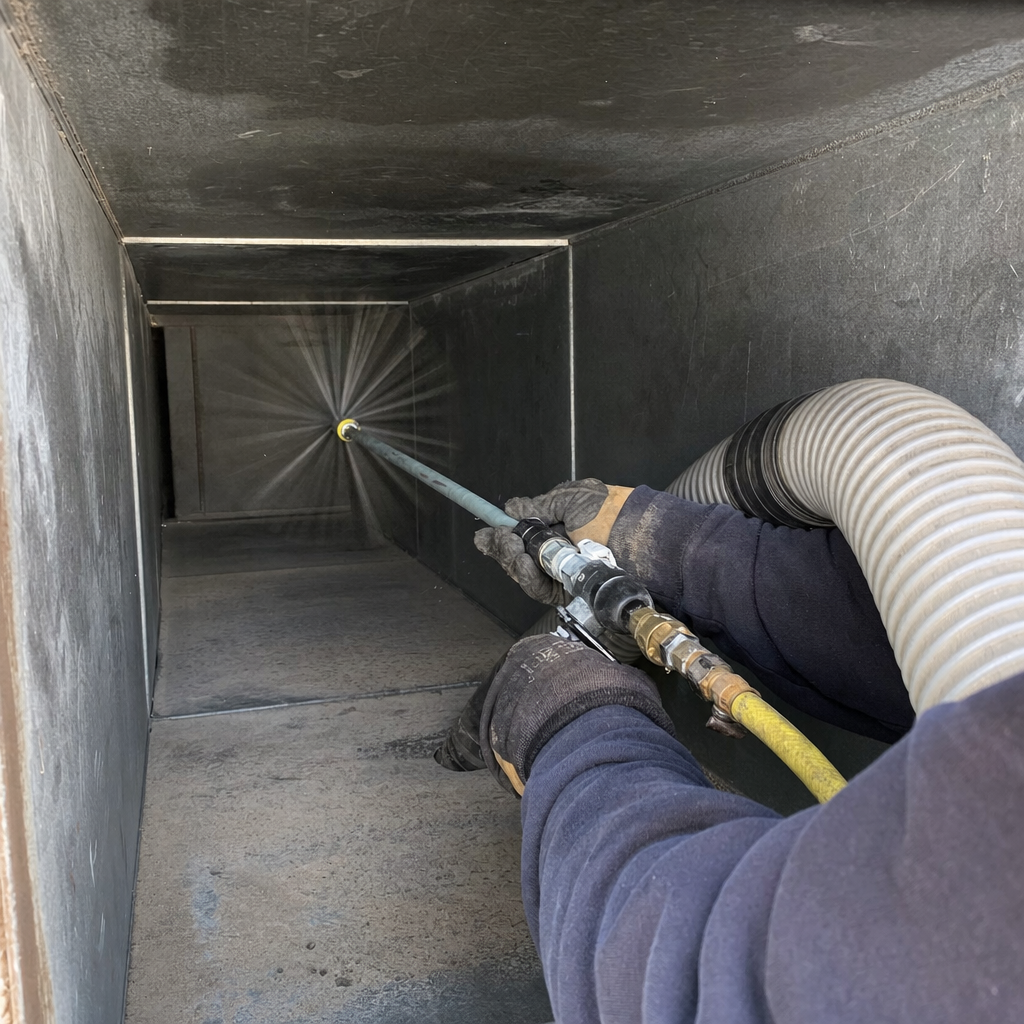
- DIY compressed air “cleaning.” Blowing a leaf blower into your register doesn’t clean ducts — it redistributes debris into areas you can’t reach, damages flexible duct connections, and can force particulate past the blower motor into the heat exchanger. We’ve repaired the aftermath.
- Waiting for visible dust on furniture. By the time you’re dusting daily, your ducts have been saturated for months. The visible symptom lags the actual problem by 60–90 days in most systems.
- Hiring based on price alone for post-renovation cleaning. Construction debris requires contractor-grade extraction equipment — Rotobrush, Nikro, or equivalent — and HEPA containment. A low-bid operator with inadequate equipment will leave abrasive drywall compound in your system to circulate for years.
- Neglecting the dryer vent because “it’s not part of the HVAC.” In New York City’s fire statistics, this is the most expensive oversight a homeowner can make. Annual inspection costs less than your insurance deductible.
When to Call a Professional
Some conditions exceed DIY management and require specialized equipment. Call for professional assessment if you detect mold growth (any color, any amount), persistent odors that survive filter changes, visible moisture or rust in ductwork, post-renovation debris, or dryer vent restrictions that persist after cleaning the lint trap and transition duct. Carbon monoxide alarms, soot around supply registers, or burning smells demand immediate HVAC service before any cleaning discussion.
For comprehensive air duct, HVAC, and dryer vent cleaning, Air Duct Cleaning in Buffalo and throughout New York City is available from Landmark Air Duct Cleaning Service New York. Richard Anderson — owner and lead technician — handles your job personally, bringing two decades of focused specialization and contractor-grade equipment most residential crews never carry. Free estimates: call (833) 754-6107.
Frequently Asked Questions
Every 3–5 years for typical residential systems, or 2–3 years if you have pets, allergies, or live near major construction. Post-renovation cleaning should happen immediately after construction completion, before occupying the space. Call (833) 754-6107 for a free estimate on your specific situation — estimates are free and come with no pressure to book.
New York City’s air quality index averages 20–40% higher particulate load than the suburban and rural conditions used for manufacturer testing. Construction dust, traffic emissions, and seasonal pollen from Central Park and the Hudson River corridor all accelerate filter loading. Check monthly and replace based on visual inspection, not the printed schedule.
No — not effectively, and potentially destructively. Residential shop vacs lack the CFM and HEPA containment to extract rather than redistribute debris, and the agitation tools (whips, brushes) that break bonded deposits loose from duct walls require professional training to use without damaging flex duct or knocking loose connections. For what you’d spend renting inadequate equipment, professional service with proper tools is comparable and far more effective.
Duct cleaning addresses the distribution pathways (supply and return trunk lines, branches, and registers). HVAC cleaning includes the blower motor, evaporator coil, and heat exchanger — the components that condition air before distribution. In New York City’s humid climate, evaporator mold is a common issue that duct cleaning alone won’t resolve. We offer both services, often in a single visit, because partial cleaning leaves the problem partially intact.
Ask for before-and-after photos from inside your specific ductwork, not stock images. Verify they’re using agitation equipment (rotary brushes or compressed air whips) plus negative air collection — suction alone doesn’t dislodge bonded debris. 548 customers, 4.9 stars — results you can verify before you book. At Landmark, Richard Anderson shows you the condition of your system in real time and explains what he’s finding as he works.
It depends on lease terms and your length of stay. If you’re in a New York City rental for more than two years and have no record of prior cleaning, the accumulated debris from previous tenants affects your air quality now. For rent-stabilized tenants with long-term occupancy, it’s often worth negotiating with the landlord or splitting costs. For short-term rentals, focus on filter changes and register cleaning within your control, and document any visible mold or debris for your landlord.
The Bottom Line
Air duct maintenance in New York City isn’t a quarterly chore you outsource to memory — it’s a diagnostic rhythm tuned to our specific urban environment. The homeowners who spend five minutes monthly and thirty minutes seasonally catch problems when they’re filter changes, not blower replacements. They document what they find, adjust intervals based on actual conditions rather than packaging claims, and know the difference between normal accumulation and warning signs. From cleaning to repair to sanitizing — one call closes the loop on your air quality. When the job exceeds your tools or your time, call someone who brings contractor-grade equipment and personal accountability to every visit.
Written by Richard Anderson, Owner & Lead Technician at Landmark Air Duct Cleaning Service New York, serving New York City since 2006.