
Signs You Need Dryer Vent Cleaning in New York, NY — And the One Most People Miss
The clearest signs you need dryer vent cleaning are clothes that stay damp after a full cycle, a dryer exterior that gets too hot to touch, and a termination cap on your exterior wall or roof that barely opens when the dryer runs. In New York City’s dense housing stock — where vent runs routinely stretch 20 to 35 feet through multiple interior walls and shared chases — that sluggish termination cap is actually the earliest reliable warning, appearing weeks before any performance symptom most homeowners recognize. If you’re seeing any of these signals, call Landmark Air Duct Cleaning Service New York at (833) 754-6107 for a free assessment.
Why New York Dryer Vents Fail Differently Than Suburban Systems
Richard Anderson — owner and lead technician at Landmark — grew up in Woodside, Queens, a few blocks from the elevated 7 train, and has spent the last 20 years pulling apart ducts in just about every building type New York throws at you. He’s learned that the standard advice you’ll find online assumes a house in the suburbs: short vertical run, direct exterior exit, plenty of airflow. That advice can get a New Yorker killed.
In a typical Brooklyn rowhouse, your dryer vent might run 25 feet horizontally through two interior walls, make a 90-degree turn into a chase shared with your neighbor’s unit, then exit through a termination cap three stories up that’s partially blocked by years of accumulated lint from multiple apartments. The lint doesn’t just sit there — it compacts. New York’s humidity, especially in summer months when basement and first-floor units battle groundwater seepage, turns that lint into dense, almost felt-like material that standard cleaning brushes sometimes can’t touch on the first pass.
We’ve pulled out blockages in Park Slope and Bed-Stuy that required full auger extensions on our Nikro equipment and multiple passes before airflow returned to spec. The difference between recognizing that kind of complex-run blockage and missing it entirely is two decades of seeing what’s actually inside.
The Early Warning Sign Almost Nobody Checks
By the time your dryer takes two cycles to finish a load of towels, the restriction is usually severe. But there’s a check you can make without tools, without disassembling anything, and without waiting for your energy bill to spike: go outside and watch your termination cap while the dryer runs.
In a properly functioning system, the cap’s flapper or louvers should snap open briskly from the force of exhausted air. If they barely lift, flutter weakly, or don’t open at all, you have a restriction — period. It might be lint buildup in a horizontal section, a bird nest in the cap (common in spring on Brooklyn and Queens low-rises), or a partially collapsed flexible duct behind the dryer. Whatever the cause, the cap’s behavior tells you the story before your clothes do.
We’ve responded to calls in Astoria where the homeowner reported “a little lint around the flap” and found 40% airflow restriction in a 30-foot run. We’ve also had Upper West Side co-op residents tell us their dryer “seems fine” while their termination cap sat motionless during operation — the lint was so compacted in a shared chase that air had found alternate paths, creating a fire hazard the resident couldn’t feel from inside.
How to Check Your Termination Cap Safely
- Run your dryer on high heat for 3-5 minutes first — you need the blower at full output
- Locate the exterior cap (wall, roof, or in some Manhattan buildings, a mechanical shaft)
- Observe whether the flapper/louvers open fully and stay open steadily
- Note any rattling, vibration, or intermittent closure — these indicate turbulent airflow from partial blockage
- Check for condensation staining or water marks on the wall below the cap (more on this below)
If the cap doesn’t open decisively, you have a restriction worth addressing. In New York’s older housing stock, this is not a “wait and see” situation.
The Moisture Signal You’ll Only See in Humid-Climate Apartments
Here’s something you won’t find on standard checklists: condensation or water staining on the exterior wall near your vent termination. In New York’s climate — humid summers, freeze-thaw winters, and buildings where interior and exterior temperatures create constant vapor pressure differentials — a partially blocked dryer vent traps humid air in the run. That moisture condenses on the cooler duct surfaces, runs back toward the termination, and shows up as staining or even minor efflorescence on brick or stucco.
We’ve seen this pattern repeatedly in pre-war buildings in Washington Heights, Inwood, and the Bronx, where uninsulated duct runs pass through exterior walls that stay cold in winter. The homeowner assumes it’s a roof leak or masonry problem. A contractor quotes them thousands for pointing or waterproofing. What they actually need is a dryer vent cleaning to restore proper airflow and stop the condensation cycle.
Richard’s rule: if you see moisture where dry air should be exiting, something’s blocking that exit. In 20 years, he’s never found an exception.
When Your Problem Is Actually Your Neighbor’s Lint
New York’s multi-unit buildings create a scenario almost unique to dense urban housing: shared vent chases. In co-ops and condos throughout Manhattan, Brooklyn, and Queens, multiple units often exhaust into a common duct system before reaching the roof. Your dryer might be clean, your habits impeccable, and your termination cap still barely functional because Unit 4B’s lint has been accumulating in the shared horizontal section for three years.
The symptoms in your unit — longer dry times, hotter dryer surface — have nothing to do with your own dryer habits. This is why building management in larger co-ops should schedule annual inspection and cleaning of shared chases, but many don’t. We’ve been called into buildings on the Upper East Side where three separate units had independently replaced their dryers, assuming the appliance was at fault, when the real problem was a packed shared chase that no individual owner could access.
If you’re in a multi-unit building and experiencing symptoms despite a relatively short individual run, ask your super or management company about the last time the shared chase was inspected. Our Dryer Vent Cleaning in New York service includes assessment of shared system segments where building access allows.
The Standard Signs — And Why They Mean More Here
The warnings you’ll find on fire department websites and appliance manuals aren’t wrong. They’re just late-stage in New York’s context. Here’s what they mean when they appear in our market:
- Clothes need two cycles to dry: In a short-run suburban system, this might mean moderate lint buildup. In a 30-foot NYC run with multiple bends, this typically indicates 60-70% airflow restriction — well into elevated fire risk territory
- Dryer exterior too hot to touch: The appliance is working against backpressure, overheating the drum motor and creating ignition risk at the heating element. In our experience, this appears when restriction exceeds 50%
- Burning smell during operation: Lint has reached the heating element or motor housing. This is an active fire hazard — stop using the dryer and call for service immediately
- Visible lint around interior dryer door seal: Air is finding alternate paths because the exhaust is blocked. The lint you see is what’s escaping; far more is trapped in the run
- Excessive humidity in laundry area: Moist air is backing up into the room instead of exiting. In New York basements, this compounds existing moisture problems and can trigger mold growth on adjacent surfaces
Common Local Scenarios We See on New York Jobs
Every building type presents its own pattern. Here are the situations Richard encounters regularly:
The Pre-War Walk-Up (Washington Heights, Inwood, parts of the Bronx)
Original plaster walls, no dedicated laundry closet, dryer installed in a converted pantry or hallway niche. The vent run was never designed for this appliance — it’s a retrofit through 18-inch masonry walls with improvised transitions. Lint packs at the first elbow, usually within 18 months of installation. We use Rotobrush systems with flexible shaft extensions to navigate these tight geometries without damaging fragile old plaster.
The Brooklyn Rowhouse (Park Slope, Bed-Stuy, Crown Heights)
Three to four stories, dryer in the basement, vent runs 25-35 feet horizontally before turning vertical to exit through a rear wall or roof. The horizontal section is where lint settles — gravity works against you here. We’ve pulled out blockages in these runs that weighed several pounds and had the density of compressed felt. The Abatement Technologies negative-air systems we deploy can generate sufficient suction to dislodge material that brushes alone won’t touch.
The High-Rise Condo (Manhattan, Long Island City, Downtown Brooklyn)
Dryer in a dedicated closet with what appears to be a short run — but it’s connected to a shared chase serving 15+ units. The individual run looks clean; the problem is 40 feet away in a common duct no single owner maintains. We coordinate with building management for these jobs, documenting restriction points with camera inspection when access allows.
The Recent Renovation (All neighborhoods)
New kitchen, new bath, drywall dust everywhere — including inside the dryer vent if contractors didn’t seal it during work. Construction debris accelerates lint accumulation and can create sudden, severe restrictions. We always recommend vent inspection post-renovation, especially when the laundry area was part of the work zone.
What Professional Dryer Vent Cleaning Actually Involves
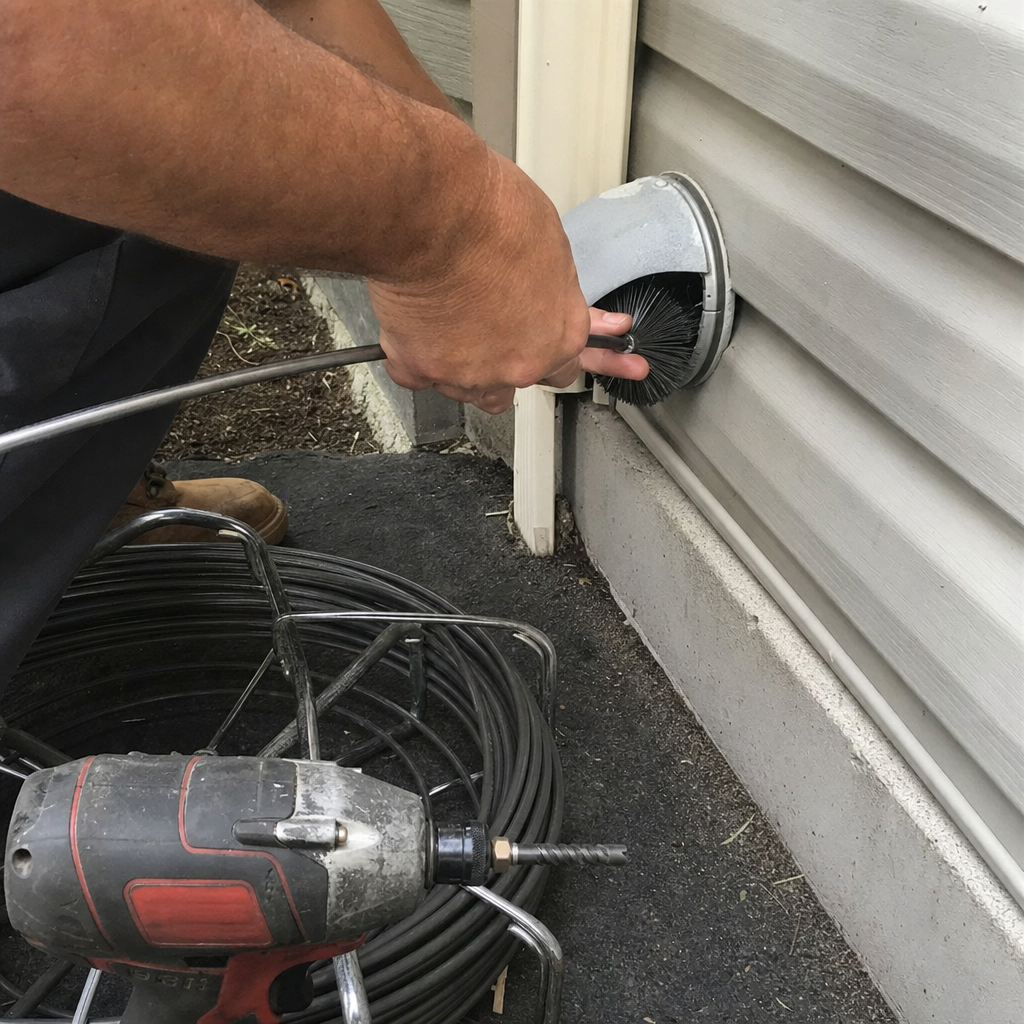
When Landmark arrives for a Dryer Vent Cleaning appointment, Richard Anderson personally assesses the full run — not just the accessible sections. We use contractor-grade equipment that most residential crews don’t carry: Rotobrush mechanical brushing systems for dislodging compacted lint, Nikro high-velocity vacuums for extraction, and camera inspection where geometry makes visual confirmation impossible.
For New York’s complex runs, we typically need to access multiple points — the termination cap, any intermediate cleanouts, and the connection behind the dryer itself. A “cleaning” that only brushes the first six feet and vacuums the lint trap area is worse than useless; it gives you false confidence while the fire hazard remains in the wall.
Our process:
- Airflow measurement at the termination cap before and after — objective proof of improvement
- Mechanical brushing of the full run length with diameter-matched brushes
- Negative-air extraction to remove dislodged material without contaminating your space
- Camera verification in runs with bends or suspected damage
- Reconnection with proper materials (we replace flexible transition duct with rigid or semi-rigid where code allows)
- Final airflow test and documentation
I’ll tell you what you need. I won’t sell you what you don’t. If your run is clear and your cap is functioning, we’ll tell you that and leave — no charge for the assessment.
What This Costs in the New York Market
Dryer vent cleaning pricing varies with run length, accessibility, and whether we need to coordinate building access for shared chases. If you’re wondering How Much Does Dryer Vent Cleaning Cost? (2026 Price Guide) — New York, NY, here’s what Landmark typically sees in the New York market:
| Service Level | Typical Range | What It Covers |
|---|---|---|
| Standard residential cleaning (single-family, short run) | $150 – $225 | Up to 15 feet, accessible termination, no building coordination needed |
| Extended run cleaning (multi-story, multiple bends) | $225 – $350 | 15-35 feet, mechanical brushing, camera verification if indicated |
| Shared chase / multi-unit coordination | $300 – $450 | Building access, shared segment cleaning, individual unit runs, documentation for management |
| Repair / replacement of damaged duct sections | $75 – $200 additional | Material and labor for rigid duct replacement, proper sealing, code-compliant transitions |
These are ranges based on our 20 years of New York pricing — your specific job may fall outside them depending on access complexity. Call (833) 754-6107 for an exact quote; estimates are free and no-pressure.
FAQs
Most residential dryer vent cleanings in New York run $150-$350 depending on run length and accessibility, with shared multi-unit chases toward the higher end. Landmark provides free estimates before any work begins — call (833) 754-6107 for your specific quote.
We often have same-day availability for urgent situations — burning smells, complete airflow failure, or dryer overheating. Standard appointments typically schedule within 48 hours. If you’re seeing active fire-risk symptoms, tell us when you call and we’ll prioritize your job.
Consumer-grade dryer vent cleaning kits ($20-$40 at hardware stores) reach only the first few feet of most runs and lack the suction power to extract dislodged lint — they often make blockages worse by compacting material deeper into the duct. In New York’s extended runs with multiple bends, professional equipment and camera verification are necessary for actual clearance. Landmark delivers Best Dryer Vent Cleaning in New York, NY — the cost of a proper cleaning is minor compared to fire damage, energy waste, or premature dryer replacement.
For single-family homes with short runs, every 2-3 years is typical. In New York’s multi-unit buildings with extended or shared runs, annual inspection is prudent — especially in pre-war buildings with original ductwork or any building with shared chases. High-usage households (families with children, home-based businesses doing frequent laundry) should inspect annually regardless of building type.
When to Call — And What to Expect
If your termination cap barely opens, if you’ve noticed moisture staining near the vent exit, if your building has shared chases that haven’t been inspected in years, or if any of the standard warning signs have appeared, it’s worth having Richard Anderson take a look. Landmark offers Affordable Dryer Vent Cleaning in New York, NY without cutting corners on thoroughness. With 548 verified reviews averaging 4.9 stars and two decades of specialized duct work — not generalist HVAC services — Landmark Air Duct Cleaning Service New York brings equipment and experience that franchise crews and rotating subcontractors simply don’t match.
From cleaning to repair to sanitizing, one call closes the loop on your air quality. If you’d rather have it looked at, Landmark Air Duct Cleaning Service New York offers a no-pressure assessment in New York — call (833) 754-6107 for a free estimate.
Written by Richard Anderson, Owner & Lead Technician at Landmark Air Duct Cleaning Service New York, serving New York, NY.