
Is Air Duct Cleaning Worth It in New York? Only If the Job’s Done Right
Air duct cleaning is worth it in New York when your system actually needs it and the work is performed with proper source-removal equipment — not a shop vac and a brush. For most Manhattan and Brooklyn buildings, the real question isn’t whether duct cleaning works, but whether your contractor can distinguish between a system that needs cleaning and one that needs a better filter or sealed ductwork. Call (833) 754-6107 and we’ll tell you straight which category you’re in.
Richard Anderson — owner and lead technician at Landmark Air Duct Cleaning Service New York — grew up in Woodside, Queens, a few blocks from the elevated 7 train, and has spent the last 20 years cleaning air ducts in just about every type of building New York throws at you. He’s pulled apart systems in pre-war walk-ups in Washington Heights, high-rise condos in Long Island City, and commercial kitchens in the Flatiron District. The EPA’s famous line that “duct cleaning has never been shown to prevent health problems” gets quoted constantly by companies selling $99 whole-house specials. What rarely gets quoted is the very next sentence: “neither do studies conclusively demonstrate that particle levels in homes increase because of dirty air ducts.” The honest answer is more nuanced than most blog posts want it to be, and it depends heavily on who’s doing the work and how.
Why the Research on Duct Cleaning Looks Mixed — And What It Actually Means
The skepticism you read about duct cleaning effectiveness isn’t wrong, but it’s largely a study of bad technique, not a verdict on the service itself. Most research — including the EPA’s cautious stance — examines residential duct cleaning as a broad category without distinguishing between source removal and surface agitation. That’s like evaluating dentistry by lumping together a hygienist’s scaling and someone brushing their teeth harder.
Here’s what actually happens in the field:
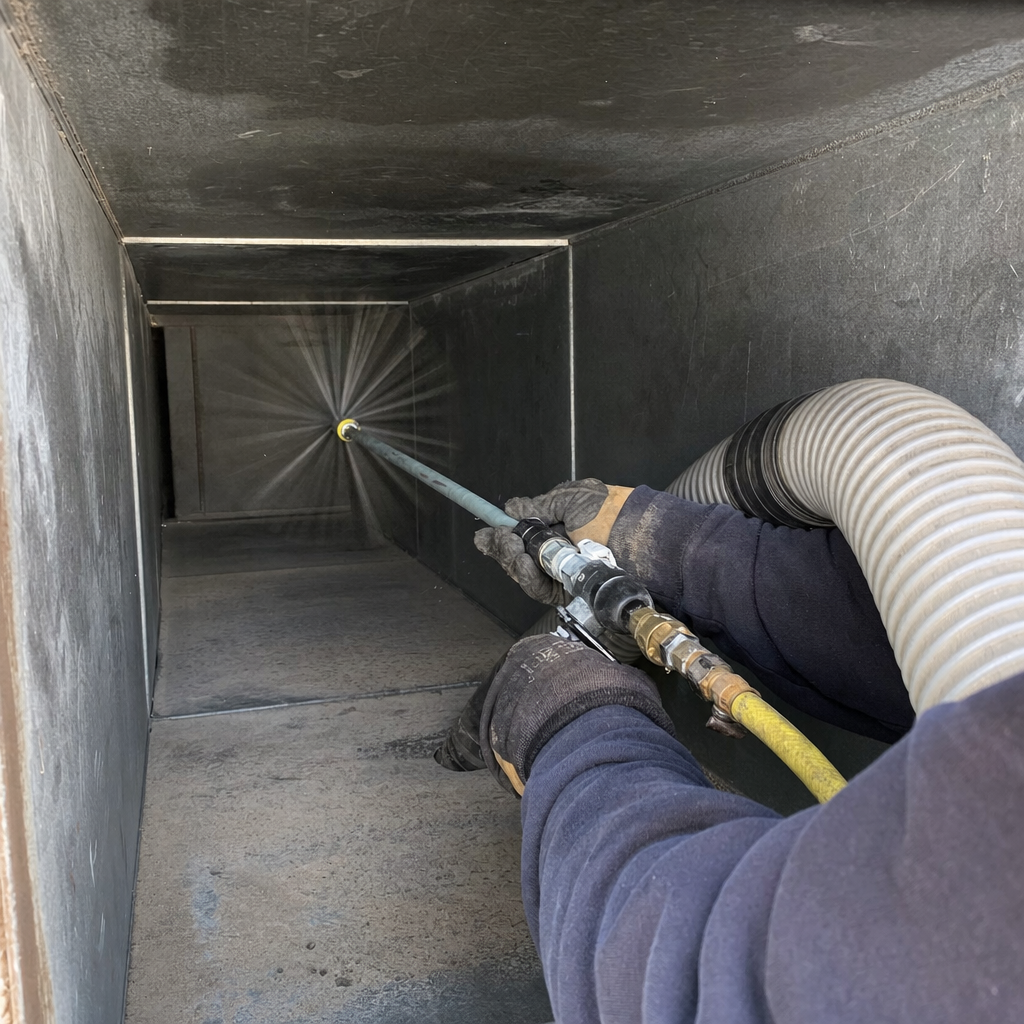
- Source removal — what we perform with negative air machines from Abatement Technologies and rotary brush systems from Rotobrush — creates controlled suction at 2,000+ CFM while agitating debris at the source. The contaminant is captured at the point of disturbance and removed from your building entirely. This is the method NADCA certifies and the one that produces measurable before-and-after results.
- Surface agitation — what happens with underpowered consumer units or low-bid contractors using portable shop vacs — knocks debris loose without sufficient airflow to transport it out of the system. You’ve just redistributed the load through your supply registers. This is why some studies show no improvement: the “cleaning” never actually removed anything.
Richard’s seen the aftermath of both approaches. In a 1920s brownstone near Prospect Park, a previous “cleaning” had left a layer of construction dust packed so tightly against the evaporator coil that the system was drawing 40% more electricity to maintain airflow. The homeowner had paid $129 for a service that made the problem worse. We extracted 11 pounds of compacted debris with a Nikro negative air system and restored the static pressure to manufacturer spec. That’s the difference between worth it and wasted money.
When Duct Cleaning Delivers Measurable Results in New York Buildings
New York’s housing stock and urban environment create specific scenarios where professional duct cleaning isn’t just worth it — it’s the most cost-effective intervention available. These aren’t theoretical benefits; they’re patterns Richard has documented across two decades of inspections.
Post-Renovation Dust in Gut-Renovated Brownstones and Pre-War Buildings
Manhattan and Brooklyn’s renovation cycle means thousands of units annually are reconfigured with walls removed, floors sanded, and plaster ground down — all while the HVAC system was either running or left open to the work zone. In a gut-renovated brownstone in Bed-Stuy, Richard found drywall compound and hardwood particulate packed into the return trunk at depths exceeding three inches. The homeowner’s HEPA air purifier was working overtime because the duct system was functioning as a reservoir, reintroducing construction debris every time the blower cycled. Source removal dropped the airborne particle count by 60% within 48 hours — verified with a particle counter the client had purchased during their frustration with persistent dust.
The critical factor: post-renovation cleaning must happen before the system has run for months grinding debris into the coil and blower assembly. Wait too long, and you’re looking at Air Duct Cleaning plus HVAC cleaning, which adds cost but may still be necessary.
Systems Converted from Steam Heat to Forced Air
In Queens and parts of the Bronx, Richard regularly encounters buildings where steam radiators were removed and ductwork was retrofit through existing chases — often with minimal attention to sealing or filtration. These systems pull return air through wall cavities that have never been cleaned and may contain decades of plaster degradation, mouse droppings, and insulation particulate. In a Jackson Heights co-op built in 1938, the converted system’s return was drawing through an unsealed chase that opened into the building’s original coal bin. No filter upgrade fixes that; only physical removal and duct sealing addresses the source.
Urban PM2.5 Infiltration Through Return Air Pathways
New York’s outdoor air quality — while improved from decades past — still delivers particulate loads that exceed suburban and rural environments, particularly during summer ozone episodes and winter inversion layers. Buildings near major thoroughfares in Midtown, the Cross Bronx Expressway corridor, or industrial zones in Greenpoint and Sunset Park experience accelerated filter loading and duct deposition. More critically, many New York buildings have return air pathways that aren’t fully sealed, pulling air from wall cavities, basements, and elevator shafts rather than conditioned space. The debris in those pathways isn’t “normal household dust” — it’s a concentrated urban particulate mix that includes brake dust, tire fragments, and combustion byproducts. Cleaning these pathways and sealing the returns is often the intervention that makes a persistent air quality complaint finally resolve.
Visible Mold Growth or Chronic Moisture Issues
When mold is present in ductwork — often where uninsulated sheet metal passes through humid basement spaces or where condensate drainage has failed — cleaning is not optional. It’s remediation. Richard uses borate-based sanitizing agents applied after mechanical removal, with moisture source identification as a mandatory parallel step. Cleaning moldy ducts without fixing the moisture condition is worth nothing; it’ll be back in six months.
When Duct Cleaning Is NOT Worth It — And We’ll Tell You So
This is where Landmark diverges from the franchise model. Richard’s built the business on a principle he states flatly: “I’ll tell you what you need. I won’t sell you what you don’t.” In 20 years, he’s declined to clean systems that didn’t need it — and those homeowners have become some of his most reliable referral sources.
Here are the scenarios where we recommend against duct cleaning:
- Your system was cleaned within 2-3 years and you have no new contamination source. Annual cleaning is unnecessary for most residential systems and serves primarily as a revenue stream for subscription-model franchises.
- Your only complaint is a vague sense that “the air feels stale.” This often indicates inadequate ventilation rate or a failing filter, not dirty ducts. A MERV 13 filter upgrade and blower compartment inspection typically costs under $200 and addresses the actual problem.
- You have no return ductwork — only a plenum system. Some older New York buildings circulate air through building cavities rather than dedicated ducts. These systems can’t be cleaned effectively without structural access, and the money is better spent on sealing and filtration.
- Your ducts are visibly intact but your real problem is a contaminated evaporator coil or blower. We perform HVAC cleaning as a separate service, and it’s often the correct intervention when ducts themselves test clean.
In a recent inspection on the Upper West Side, a property manager was prepared to authorize full duct cleaning for a 24-unit building based on tenant complaints. Richard’s camera inspection showed clean mains with debris concentrated at three failed flex-duct connections in the basement. The repair and spot cleaning cost 15% of the quoted full-system price. That’s the assessment-first approach — and it’s why our Air Duct Cleaning in New York service starts with inspection, not assumption.
What Professional Duct Cleaning Actually Costs in New York
Pricing transparency matters because the low-bid trap is how homeowners end up with the surface-agitation problem described above, which is why affordable air duct cleaning in New York, NY still means legitimate source-removal work. These ranges reflect what legitimate source-removal work costs in the New York market, using contractor-grade equipment and performed by a NADCA-informed technician — not a commission-driven upsell operation.
| Service Scope | Typical Range | What Affects Price |
|---|---|---|
| Residential single-system cleaning (apartment/small house) | $400 – $700 | Number of vents, accessibility, contamination level |
| Residential multi-zone or large single-family | $700 – $1,200 | Duct complexity, system age, need for access panel installation |
| Co-op/condo building — common system | $1,500 – $4,000 | System size, riser access, coordination with building management |
| HVAC cleaning (coil, blower, cabinet) | $300 – $600 | Coil condition, refrigerant handling requirements |
| Duct repair & sealing (per linear foot or spot) | $200 – $800 | Location of leaks, material (mastic vs. tape vs. replacement) |
| Air quality sanitizing (post-cleaning application) | $150 – $350 | System size, product selection |
The $99 whole-house special is a loss-leader for upsells or a surface-agitation service that redistributes debris — how much does air duct cleaning cost? enough for real equipment, or it isn’t real cleaning. Professional-grade negative air equipment, HEPA filtration, and rotary brush systems represent real capital investment — Rotobrush and Nikro units run $8,000–$15,000 per truck, and Abatement Technologies portable HEPA extractors add another $4,000–$6,000. A legitimate operator has to charge accordingly or they’re not running that equipment.
We provide written, itemized estimates before any work begins. Call (833) 754-6107 for a free assessment with exact pricing for your system.
How to Verify Whether Your System Actually Needs Cleaning
Richard’s inspection protocol — developed over 20 years and thousands of New York buildings — gives you an evidence-based answer rather than a sales pitch. Here’s what we check:
- Visual inspection of supply and return registers — debris accumulation at register faces often indicates upstream loading
- Camera inspection of main trunk lines — we document condition with photo/video evidence you can review
- Static pressure measurement — elevated pressure drop across the system indicates airflow restriction
- Blower compartment and evaporator coil assessment — often the real source of air quality complaints
- Filter evaluation and fit check — a 1-inch filter rattling in a 2-inch slot is bypassing 30% of your air unfiltered
- Return pathway integrity — particularly critical in New York’s converted and multi-unit buildings
This inspection takes 30–45 minutes and costs nothing. You’ll receive a written recommendation with photos, and if cleaning isn’t indicated, we’ll tell you what intervention actually addresses your concern — whether that’s a Guardsman or Aprilaire filter upgrade, duct sealing, or HVAC maintenance.
What 548 Reviews at 4.9 Stars Actually Means in This Trade
The review volume matters because duct cleaning is a service people book reluctantly and review only when something goes notably right or wrong. A 4.9-star average across 548 verified reviews indicates consistent execution across a large sample — not a handful of cherry-picked testimonials. The pattern in our reviews: customers mention that Richard (specifically, by name) explained what he found, showed them the evidence, and either performed the work or recommended against it. That accountability structure — owner as lead technician, same person who answers the phone does the work — is impossible in franchise operations where technicians rotate weekly and commission structures incentivize maximum ticket size.
Two decades of duct work, not generalist HVAC services. Contractor-grade equipment most residential crews never carry. From cleaning to repair to sanitizing — one call closes the loop on your air quality. These aren’t taglines; they’re the operational reality that determines whether your duct cleaning investment returns actual value.
FAQs
Professional source-removal duct cleaning in New York typically runs $400–$700 for a standard residential system and $700–$1,200 for larger or multi-zone homes, with whole house air duct cleaning cost in New York, NY for co-op and condo common systems ranging $1,500–$4,000 depending on size and access. The $99 specials use underpowered equipment that redistributes debris rather than removing it. Call (833) 754-6107 for a free, itemized estimate based on your actual system — estimates are free and come with no booking pressure.
Duct cleaning can reduce allergen reservoirs in your HVAC system, but it’s not a medical treatment and won’t replace source control in your living space. In New York’s dense housing, the most common allergy improvement we see follows cleaning in post-renovation units or buildings with chronic moisture issues where the duct system has become a holding tank for dust mite debris, mold spores, or construction particulate. Richard will inspect your specific system and tell you whether the debris load justifies cleaning or whether your money is better spent on a sealed MERV 13+ filtration upgrade.
For most New York residential systems without special risk factors, every 3–5 years is adequate; annual cleaning is unnecessary and often reflects franchise subscription pressure rather than actual need. Systems should be inspected sooner after major renovation, visible mold growth, pest infestation, or if you’ve never had them assessed in a building older than 30 years. We inspect first and recommend based on what we find — not on a calendar schedule.
Cleaning is almost always cheaper than replacement — typically 10–20% of the cost for accessible metal ductwork — but replacement becomes necessary when ducts are deteriorated galvanized steel with pinhole leaks, asbestos-containing transite pipe, or flex-duct that’s collapsed internally. In New York’s pre-war buildings, we often find that duct repair and sealing extends system life significantly at a fraction of replacement cost. Richard assesses structural integrity during inspection and will recommend replacement only when cleaning or repair is genuinely uneconomical.
If you’d rather have it looked at, Landmark Air Duct Cleaning Service New York offers a no-pressure assessment in New York — call (833) 754-6107. Richard Anderson handles the inspection personally, and you’ll get a straight answer about whether your system needs work, what kind, and what it will cost before any commitment.
Written by Richard Anderson, Owner & Lead Technician at Landmark Air Duct Cleaning Service New York, serving New York, NY.