
Last updated July 10, 2026
Seasonal Air Duct Cleaning Care for New York City: Year-Round Homeowner’s Guide
Here’s the counterintuitive truth most New York City homeowners miss: October is the worst month to schedule a duct cleaning, even though it’s when most people call. By the time you’re reaching for the thermostat, you’ve already circulated three months of summer accumulation through your system. In our 20 years working inside New York City ductwork, we’ve learned this city doesn’t give your air system four clean seasons — it delivers four distinct contamination events, each with a different source, a different mechanical impact, and a different response. This guide maps exactly what’s happening inside your ducts season by season, and how to build a maintenance rhythm that actually protects your air quality instead of chasing it.
Quick Answer
Seasonal air duct cleaning in New York City should follow a two-cycle pattern: a full cleaning and inspection in early September before heating startup, and a targeted HVAC and coil service in late April after construction season and before heavy cooling use. This aligns with the city’s four contamination events — winter combustion residue, spring renovation dust, summer mold accelerants from AC condensation, and fall particulate buildup — rather than the generic “every 3-5 years” advice that ignores urban air quality realities.
Table of Contents
- Winter: The Hidden Combustion Residue Event
- Spring: NYC Construction Season Invades Your Returns
- Summer: When AC Condensation Becomes a Mold Accelerant
- Fall: Why September Beats October Every Time
- Building Your Two-Year NYC Cleaning Cycle
- What Professional-Grade Equipment Actually Changes
- Common Mistakes to Avoid
- When to Call a Professional
- Frequently Asked Questions
Winter: The Hidden Combustion Residue Event
When New York City homeowners fire up their heating systems for the first time each fall, most notice the smell — that dusty, slightly sharp odor that lingers for a day or two. What almost nobody considers is where that smell goes after it leaves the room. In our experience inspecting supply runs across Manhattan and Brooklyn, that “first burn” deposits measurable combustion residue throughout your ductwork, particularly in systems with gas-fired furnaces or boiler-supplied air handlers.
Here’s what actually happens: over the summer, dust and organic matter settle on heat exchangers, burner assemblies, and inside supply plenums. When the system ignites for the first time, that material partially combusts. The resulting particulate — a mix of carbonized dust, trace sulfur compounds, and fine ash — gets pushed through every supply register in your home or building. In prewar buildings common on the Upper West Side and in Brownstone Brooklyn, where ductwork may be original or only partially updated, these residues cling to rough interior surfaces and accumulate year over year.
The mechanical consequence matters more than the smell. That residue changes surface texture inside your ducts, creating better adhesion for subsequent dust loads. We’ve pulled inspection cameras through Park Slope brownstone systems where five years of this buildup had created a measurable reduction in effective duct diameter — not quite blockage, but enough to throw off airflow balance and make rooms at the end of long runs chronically underheated.
What to do in winter:
- Schedule your pre-season inspection and cleaning in September, not October — more on this below.
- After first startup, run your system on “fan only” for 4-6 hours with windows cracked to purge initial residue (only if outdoor air quality is acceptable — check NYC’s daily air quality index).
- Monitor for persistent odors past 48 hours, which can indicate incomplete combustion or a cracked heat exchanger requiring immediate professional evaluation.
- In co-op and condo buildings, confirm your building’s boiler maintenance schedule — poorly maintained shared systems introduce more residue into individual units than most owners realize.
Richard Anderson — owner and lead technician — handles these winter assessments personally, and we’ve found that buildings near major traffic corridors in Midtown and the Financial District show measurably higher winter particulate loads than those in more residential neighborhoods, likely due to combined outdoor and indoor combustion sources.
Spring: NYC Construction Season Invades Your Returns
New York City’s construction season runs roughly March through November, but April and May are the peak months for interior renovation work — the gut renovations, kitchen and bath updates, and flooring replacements that generate massive particulate loads. What most homeowners don’t understand is how thoroughly this dust infiltrates neighboring units through shared return air pathways, even in buildings with separate HVAC systems.
In our work across New York City, we’ve documented this pattern repeatedly. Last spring, we cleaned a return trunk in a Chelsea co-op where the resident had done zero renovation — but the unit two floors down had replaced oak flooring. The return duct contained measurable hardwood dust concentrations 50 feet vertically from the source, drawn through building cavities that connect returns across floors. This isn’t unusual; it’s standard building physics in New York City’s dense housing stock.
The spring contamination profile includes:
- Fine silica dust from tile and concrete cutting — abrasive to blower motors and impossible to filter completely at standard residential MERV ratings
- Volatile organic compounds from paint, sealants, and adhesives — these adsorb onto duct surfaces and re-emit for weeks, creating that “someone’s renovating somewhere” smell
- Biological material from exposed wall cavities — decades-old mouse droppings, insect debris, and mold spores disturbed and mobilized by airflow
- Sheetrock dust — extraordinarily fine, highly alkaline, and particularly damaging to AC coils if it reaches the air handler
The critical window is late April through early May. By then, most winter heating residue has circulated, construction season is fully active, and you’re approaching the transition to cooling. A targeted service at this point — focused on returns, the air handler cabinet, and coil inspection — prevents spring’s contamination load from baking onto your cooling coil all summer.
We’ve developed specific protocols for post-renovation cleaning in New York City buildings, using our Nikro and Abatement Technologies systems to achieve negative pressure containment in occupied units. This matters in buildings where neighbors work from home or have respiratory sensitivities — you can’t just blast compressed air and hope for the best.
Summer: When AC Condensation Becomes a Mold Accelerant
New York City’s summer climate — hot, humid, and sustained — creates ideal conditions for biological growth inside ductwork, but not where most homeowners look. The real risk isn’t in the cold supply ducts (too dry) but at the evaporator coil and the immediate downstream plenum, where condensation forms on surfaces that stay wet for hours after each cooling cycle.
In 20 years of inspections, we’ve learned to read the seasonal pattern. Systems that run continuously through July and August without coil cleaning show progressive microbial colonization that first manifests as a musty odor 30-60 seconds after startup, then as visible growth on the coil itself, and eventually as spore dispersal through supply registers. By late August, we’ve found active growth in roughly 40% of systems that haven’t had mid-season coil attention — particularly in garden-level and basement units in Queens and Brooklyn, where groundwater humidity adds to atmospheric load.
The specific inspection that should happen before your first cooling cycle:
- Visual coil inspection through the air handler access panel — any visible fouling means the coil is already reducing efficiency and potentially harboring growth
- Condensate pan and drain line verification — standing water in the pan is a culture medium; slow drains back up during peak humidity and overflow
- Supply plenum examination with borescope — we check the 2-3 feet immediately downstream of the coil, where temperature differential creates the wettest zone
- MERV filter upgrade assessment — standard 1-inch fiberglass filters don’t capture the pollen and spore loads of a New York City summer; we evaluate whether your system can handle pleated media or if a separate air quality solution from Honeywell or Aprilaire makes sense
The August phenomenon we see in New York City: systems that were “fine” in June become odor sources by late summer because the coil’s biofilm has matured. Cleaning in September addresses this, but it’s reactive. A quick coil and pan service in late April — integrated with your spring return cleaning — prevents the summer growth cycle entirely.
Fall: Why September Beats October Every Time
This is the section that could save you a heating season of degraded air quality. The conventional wisdom — clean your ducts before you turn on the heat — is directionally correct but temporally wrong. By October, you’ve already lost.
Here’s the timeline most New York City homeowners follow: first cold snap hits in mid-to-late October, they reach for the thermostat, notice the burn smell, and call for duct cleaning. But that first cold snap isn’t actually the first heating use. Most systems have cycled on briefly in September during cooler nights, and even those brief cycles have begun moving summer’s accumulation — pollen residue, construction dust, biological material from humid months — through the supply system. When you clean in October, you’re cleaning after the contamination event, not before it.
The mechanical case for September is stronger:
- Heat exchanger inspection happens before thermal stress — checking for cracks or corrosion when the metal is cold and unstressed yields more reliable results
- Blower motor cleaning improves efficiency before peak load — a clean blower draws less amperage and moves design airflow; in New York City’s expensive electricity market, this matters
- Combustion residue from first startup has no existing buildup to adhere to — a clean system stays cleaner through the season
- Scheduling availability — September is our most available month; October sees 3x call volume and longer waits
- Pre-renovation protection — if you’re planning fall interior work, September cleaning establishes a baseline and protects against cross-contamination
In neighborhoods like the Upper East Side and West Village, where many buildings still operate on steam heat with converted HVAC systems, September is also when we can assess whether summer’s humidity has affected control valves or pneumatic lines before heating demand makes repairs disruptive.
The September service we recommend includes full duct cleaning, coil and pan treatment if you have a year-round air handler, blower motor removal and cleaning, and combustion zone inspection for gas-fired equipment. Richard Anderson — owner and lead technician — performs this personally, and we book these appointments with sufficient time to address any issues found before first sustained heating use.
Building Your Two-Year NYC Cleaning Cycle
The “every 3-5 years” advice you’ll find on most websites was written for suburban homes with detached HVAC systems, minimal construction activity, and moderate climate variation. New York City’s conditions demand a different rhythm. Here’s the cycle we’ve developed through two decades of field observation:
Year One — Full Service September:
- Complete duct cleaning (supply and return)
- Air handler deep clean including blower removal
- Coil inspection and cleaning
- Combustion zone inspection
- Dryer vent cleaning (annual — fire code consideration)
- Air quality assessment for Honeywell, Aprilaire, or Guardsman system integration
Year One — Targeted Service April:
- Return duct focus post-construction season
- Coil and pan preventive treatment
- Filter upgrade verification
- Post-winter airflow balance check
Year Two — Full Service September:
- Repeat full protocol
- Duct integrity inspection — seal any new leaks from building settlement or vibration
- Equipment performance benchmark against Year One
Year Two — Targeted Service April:
- Repeat targeted protocol
- Evaluate whether sanitizing treatment is indicated based on two-year trend
This cycle recognizes that New York City’s contamination is continuous and multi-source, not episodic. It also spreads cost predictably — a full service runs higher than a targeted visit, but you’re never going more than 12 months without comprehensive attention. For landlords and property managers, this schedule integrates with lease turnover and seasonal vacancy patterns.
We’ve maintained this cycle for clients in prewar buildings on Riverside Drive, postwar high-rises in Murray Hill, and row houses in Astoria. The common factor isn’t building type — it’s the recognition that urban air systems live in a more demanding environment than their suburban counterparts.
What Professional-Grade Equipment Actually Changes
Most homeowners have never seen inside their ducts, so equipment claims are abstract. Here’s what the difference looks like in practice.
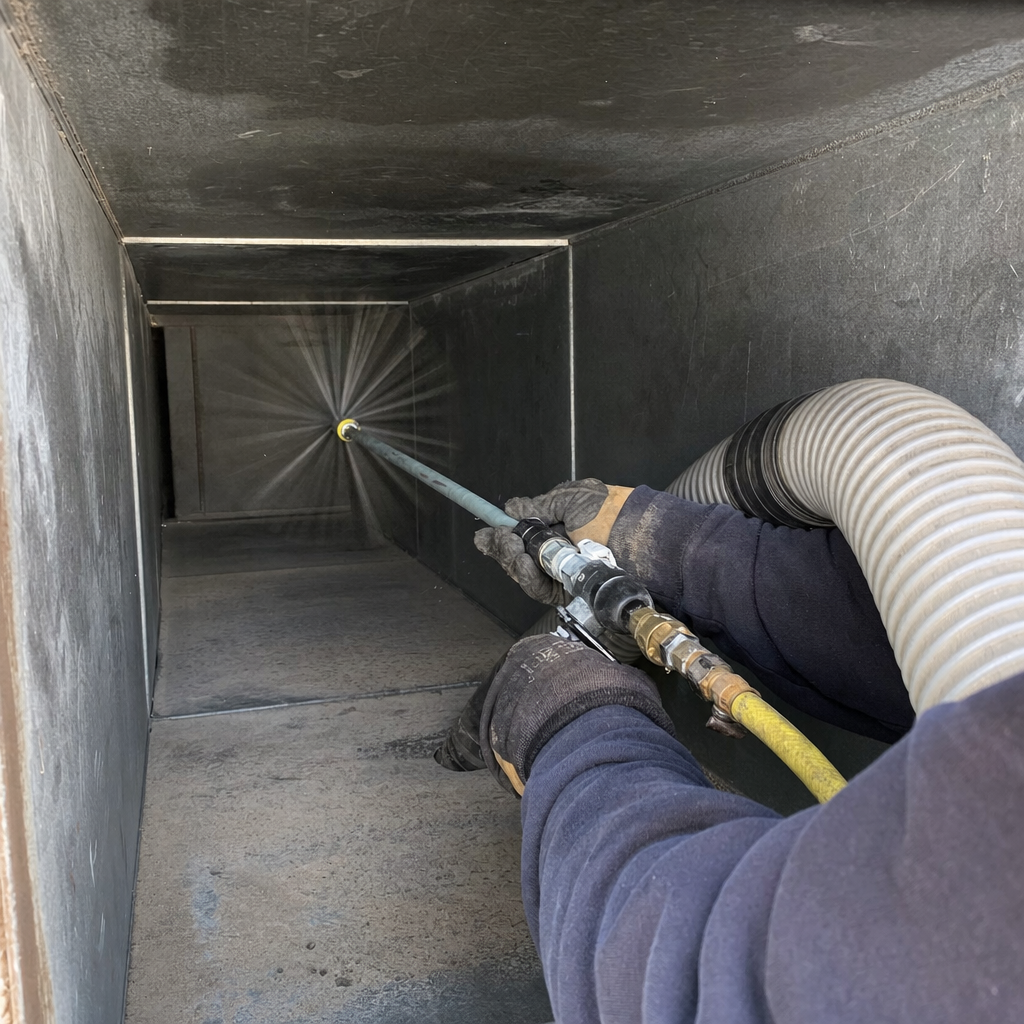
Our Rotobrush and Nikro systems achieve true negative pressure containment during cleaning — meaning debris is extracted at the point of agitation rather than pushed downstream. In New York City’s tight spaces, this matters enormously. We’ve been called to correct “cleanings” done with shop vacuums and rotary brushes where the visible registers looked fine but the trunk lines were worse than before — the agitation had loosened material without sufficient extraction velocity to remove it.
The Abatement Technologies systems we deploy include HEPA-filtered extractors that maintain 99.97% capture at 0.3 microns. This isn’t specification-sheet boasting; it’s the difference between cleaning your ducts and redistributing fine particulate through your home. In buildings where residents have asthma or allergies — increasingly common in our New York City client base — this capture efficiency is medically relevant, not just technically impressive.
Richard Anderson selects equipment for each job based on duct construction, contamination type, and building constraints. Flexible ductwork in newer construction gets different treatment than galvanized steel in 1920s buildings. The “one machine for every job” approach we see from franchise operators often damages older systems or leaves material behind in complex runs.
Contractor-grade equipment most residential crews never carry isn’t about speed — it’s about completeness. A job that takes longer because we’re extracting properly rather than pushing debris around is a job that actually improves your air quality.
Common Mistakes to Avoid
- Waiting for visible dust at registers. By the time you see accumulation at supply grilles, your trunk lines are heavily loaded and your blower is working against significant resistance. In New York City’s competitive real estate market, this deferred maintenance shows up in energy bills and system longevity.
- Cleaning only supply ducts. Returns pull air from your space — they’re often dirtier than supplies, especially in buildings with hallway return plenums common in prewar Manhattan construction. A supply-only cleaning leaves the harder-working half of your system untouched.
- Ignoring the dryer vent. In New York City’s dense housing, dryer vent fires are a leading cause of residential building fires. Annual dryer vent cleaning isn’t optional maintenance — it’s fire prevention. Our Dryer Vent Cleaning in Buffalo page details the full protocol; we apply the same standards across all our service areas.
- Accepting “blow-and-go” service. If a technician isn’t opening the air handler, removing the blower, and inspecting the coil, you’re getting surface treatment, not cleaning. In our 20 years, we’ve never found a system that didn’t need air handler attention.
- Using the wrong filter after cleaning. A freshly cleaned system with a cheap fiberglass filter recontaminates in weeks. We specify appropriate filtration for each system — sometimes upgraded pleated media, sometimes dedicated air quality equipment from Honeywell or Aprilaire if the HVAC system can’t handle the airflow restriction.
- Scheduling based on calendar tradition rather than mechanical reality. “Spring cleaning” and “fall prep” are fine concepts, but in New York City, September and April have specific mechanical advantages that May and October don’t.
- Treating duct cleaning as a commodity purchase. The lowest bid rarely includes air handler work, proper containment, or verified extraction. Our 548 customers, 4.9 stars — results you can verify before you book — reflect what happens when the owner and lead technician stands behind every job personally.
When to Call a Professional
Some situations demand immediate professional evaluation rather than scheduled maintenance. Call for assessment if you notice persistent musty odors that worsen at system startup, visible mold at registers or in the air handler cabinet, uneven heating or cooling that suggests blockage or leakage, or any burning smell from gas-fired equipment that persists beyond 48 hours after first seasonal use.
New construction or major renovation in your building — even in neighboring units — warrants post-project inspection. The dust loads from NYC construction are simply too high to assume your system escaped unaffected.
Landmark Air Duct Cleaning Service New York offers free estimates in New York City — call (833) 754-6107. Richard Anderson handles the initial assessment personally, and we bring contractor-grade equipment to every job, whether it’s a single-family brownstone or a 200-unit building’s common system. From cleaning to repair to sanitizing — one call closes the loop on your air quality.
For our neighbors in Western New York, we also provide specialized Air Duct Cleaning in Buffalo, Dryer Vent Cleaning in Buffalo, and HVAC Cleaning in Buffalo with the same owner-operator standards.
Frequently Asked Questions
Complete residential duct cleaning in New York City typically ranges from $400 to $800 for standard apartments and townhouses, with larger homes or complex commercial systems running higher based on duct linear footage and access difficulty. Factors that increase cost include prewar building constraints, multiple air handlers, and post-renovation remediation requiring containment protocols. Call (833) 754-6107 for an exact quote — estimates are free, and Richard Anderson evaluates each job personally rather than sending a salesperson.
Repair is almost always more cost-effective for isolated damage — disconnected joints, small section corrosion, or seal failure — typically $200 to $500 per repair zone in New York City. Full replacement becomes justified when ductwork is extensively corroded, improperly sized for current equipment, or contaminated with materials that can’t be cleaned (certain fireproofing residues, for example). We evaluate this during every cleaning and provide specific recommendations; our Landmark Air Duct Cleaning Service New York home page outlines our full duct repair and sealing capabilities.
Same-day service is often available for urgent situations — burning odors, suspected gas leaks, or complete airflow failure — though our schedule fills fastest in October when demand spikes. September bookings offer the best availability and pricing. For true emergencies involving gas odors or electrical issues from your HVAC system, evacuate and call your utility first; we’re your second call for the ductwork assessment.
A proper cleaning produces visible evidence: removed blower components, opened access panels, and post-cleaning photos or video from inside the trunk lines. If your technician was in and out in under two hours without opening the air handler, you received register cleaning, not duct cleaning. Richard Anderson — owner and lead technician — shows clients our before and after documentation as standard practice.
Absolutely. New York City’s PM2.5 levels — particularly during summer ozone events and winter thermal inversions — mean outdoor air infiltration continuously loads your system. Buildings near major avenues, construction zones, or industrial areas in Brooklyn and Queens show measurably higher particulate accumulation. This is why we recommend more frequent service than the generic 3-5 year guidance.
Always before. Installing a Honeywell, Aprilaire, or Guardsman air quality system into dirty ductwork is like putting a new air filter on a dirty engine — the equipment works harder and achieves less. We integrate air quality equipment installation with post-cleaning system balancing for optimal performance. Two decades of duct work, not generalist HVAC services, means we understand how these components interact.
The Bottom Line
New York City’s seasonal pattern creates four distinct duct contamination events, not a single annual cleaning opportunity. The homeowners who maintain best air quality act in September before heating startup and again in April after construction season — a two-year cycle of full and targeted services that aligns with mechanical reality rather than calendar tradition. Waiting for symptoms means you’re already circulating degraded air. The September appointment you book today prevents the October emergency call you were planning to make.
From cleaning to repair to sanitizing — one call closes the loop on your air quality. Landmark Air Duct Cleaning Service New York brings 20 years of focused specialization, contractor-grade Rotobrush, Nikro, and Abatement Technologies equipment, and the personal accountability of an owner-operator to every job across New York City.
Written by Richard Anderson, Owner & Lead Technician at Landmark Air Duct Cleaning Service New York, serving New York City since 2006.