
Last updated July 10, 2026
Air Duct Cleaning Permits, Codes & Inspections in NY: What You Need to Know
Here’s the counterintuitive truth we’ve learned after two decades in New York City homes: the duct cleaning itself almost never needs a permit, but the conversation that happens after the cleaning — about mold, about sealing, about “while we’re in there” repairs — is where homeowners unknowingly step into regulatory quicksand. We’ve been called to jobs in Park Slope and Astoria where the previous contractor found mold, offered to “treat it,” and left the owner with no paperwork, no DOL number, and a potential insurance nightmare. This guide draws the exact line between routine maintenance and work that triggers NYC or New York State compliance requirements.
Quick Answer
Standard air duct cleaning in New York City does not require a permit from the NYC Department of Buildings. However, if your contractor discovers mold and proposes remediation, replaces or alters ductwork, or performs sealing that affects airflow calculations under Local Law 97, those activities may trigger licensing, permitting, or inspection requirements under NYS Department of Labor regulations, NYC DOB codes, or energy compliance rules. Always ask for written proof of applicable licenses and permits before authorizing any work beyond cleaning.
Table of Contents
- Routine Maintenance vs. Alteration Work: Where NYC DOB Draws the Line
- When Mold Remediation Inside Ductwork Triggers NYS DOL Licensing
- Local Law 97, Energy Codes & Duct Sealing Permits
- The Insurance Angle: How Unpermitted Work Creates Coverage Gaps
- What Documents to Demand Before Any Work Begins
- Common Mistakes to Avoid
- When to Call a Professional
- Frequently Asked Questions
Routine Maintenance vs. Alteration Work: Where NYC DOB Draws the Line
The NYC Department of Buildings classifies most air duct cleaning as Type 2 maintenance — work that restores a system to its existing condition without changing capacity, routing, or materials. In our 20 years of focused duct work across New York City, from pre-war co-ops in the Upper West Side to new construction in Long Island City, we’ve never pulled a DOB permit for a standard cleaning job. The DOB’s own guidance treats duct cleaning alongside filter replacement and coil washing: necessary upkeep that doesn’t alter the building’s mechanical certificate of occupancy.
But the line shifts the moment a contractor proposes anything beyond removal of accumulated debris. Here’s how we separate the categories in practice:
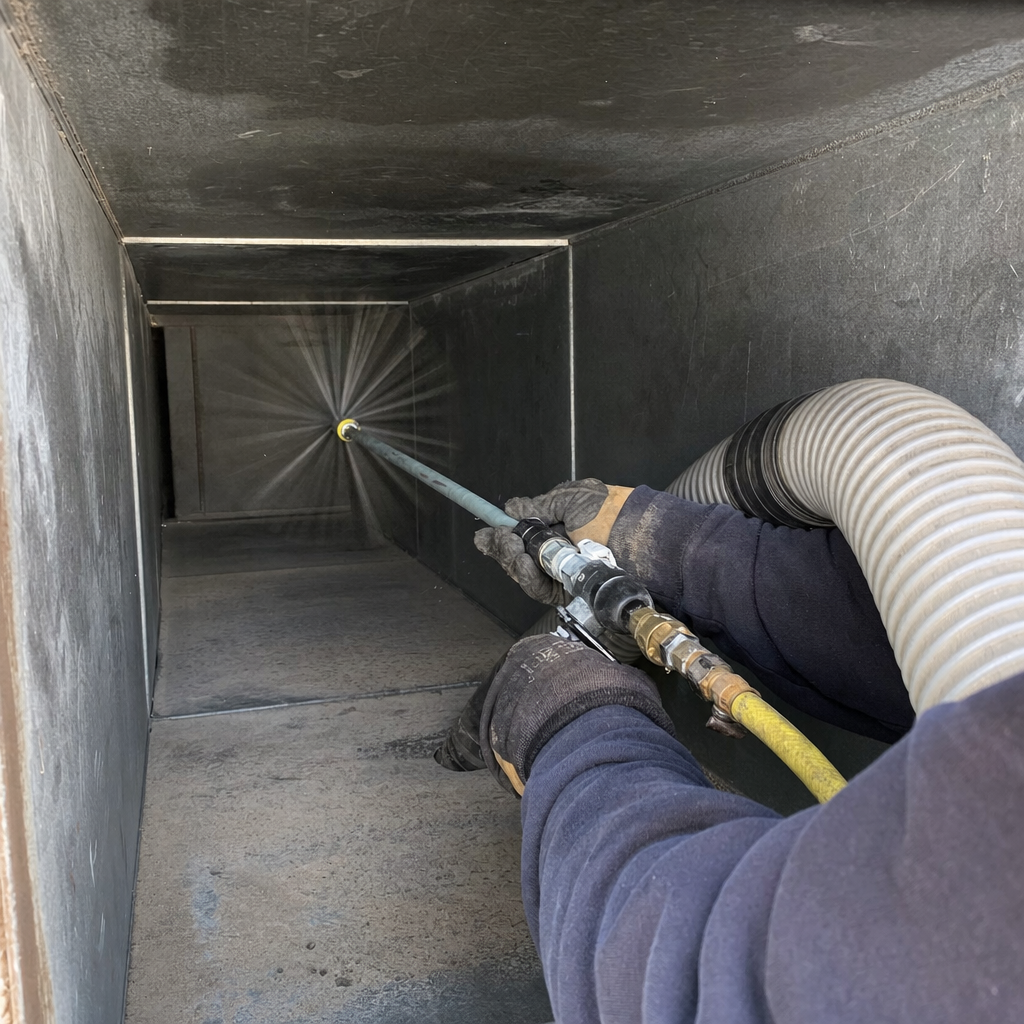
- Routine maintenance (no permit): Mechanical agitation and vacuum extraction of dust, debris, and particulate; sanitizer application that doesn’t claim to remediate mold; dryer vent cleaning from interior to exterior termination; register and grille removal for access.
- Alteration work (permit likely required): Cutting into duct walls for access panels; replacing sections of galvanized or fiberglass duct; rerouting supply or return lines; installing new dampers or balancing devices; any modification to fire-rated duct enclosures in multi-family buildings.
We’ve seen this distinction trip up homeowners in Manhattan high-rises especially. Your building’s managing agent may require notification of duct cleaning in common mechanical areas — not a DOB permit, but a compliance step with your co-op or condo’s alteration agreement. In our experience, buildings constructed before 1960 in New York City often have asbestos-containing duct tape or insulation at joints. Disturbing these materials without proper abatement certification doesn’t just violate EPA NESHAP rules — it converts your “simple cleaning” into a reportable environmental event.
The climate factor matters too. New York City’s humidity swings — summer peaks above 70% relative humidity, winter dry spells below 30% — create condensation cycles inside ductwork that accelerate corrosion and biological growth. We’ve found standing water in basement supply plenums in Queens and Brooklyn homes that owners assumed were “just dusty.” When that moisture has led to visible mold, the job crosses from maintenance into remediation territory, and that’s where the regulatory framework changes entirely.
When Mold Remediation Inside Ductwork Triggers NYS DOL Licensing
This is the scenario that keeps us up at night, because we’ve seen it mishandled dozens of times. A homeowner in New York City books a duct cleaning. The technician opens a return trunk and finds black or green growth on the interior surface. The contractor offers to “spray it down” or “treat it with antimicrobial” for an extra few hundred dollars. No testing, no containment, no written protocol — and critically, no New York State Department of Labor mold remediation license number provided.
Under New York State Labor Law Article 32, any mold remediation project exceeding 10 square feet in a residential building requires a licensed mold remediation contractor. The NYS DOL maintains a public registry; you can verify any contractor’s license status online. The law mandates specific documentation: a mold remediation work plan, a post-remediation assessment, and a clearance inspection by an independent party (not the remediator) for projects above the threshold.
Here’s what legitimate mold remediation inside ductwork must include:
- Initial assessment and sampling: A licensed mold assessor — separate from the remediator, per NYS rules — documents the extent of growth, identifies moisture sources, and specifies remediation boundaries. In ductwork, this means mapping which trunk lines, branches, and plenums are affected.
- Work plan filing: The licensed remediator submits a detailed protocol to the property owner before work begins, including containment strategy, negative air pressure requirements, PPE specifications, and disposal methods for contaminated materials.
- Containment and isolation: Physical barriers and HEPA filtration to prevent cross-contamination during disturbance. For ductwork, this often means sealing registers and operating the HVAC system under negative pressure.
- Removal, not just killing: NYS DOL guidance emphasizes physical removal of mold growth. Spraying bleach inside a metal duct and calling it done leaves dead mold fragments that remain allergenic and can become airborne when the system restarts.
- Post-remediation verification: Independent clearance sampling and visual inspection to confirm the work area meets acceptable fungal ecology standards before containment is removed.
We’ve been called to redo jobs in New York City where an unlicensed contractor “treated” mold with a fogger, charged $800, and left the homeowner with a chemical smell, wet ducts, and active growth six weeks later. In one case in Washington Heights, the improper remediation disturbed hidden asbestos tape, triggering a full abatement that cost the owner $14,000 and required DOB notification. The original contractor had vanished.
Richard Anderson — owner and lead technician — handles your job personally, and when we encounter mold during a standard cleaning, we stop, document, and refer you to a properly licensed NYS DOL remediator. We don’t blur the lines. Two decades of duct work has taught us that the shortcut always costs more.
Local Law 97, Energy Codes & Duct Sealing Permits
After a thorough cleaning, we often find that a New York City home’s ductwork has significant leakage at joints, seams, and connections. In older buildings — common in neighborhoods like Bed-Stuy, Crown Heights, and the South Bronx — we’ve measured leakage rates exceeding 30% of total airflow. That conditioned air never reaches the rooms it’s supposed to serve, and the HVAC system works harder, burns more energy, and wears out faster.
Duct sealing is a legitimate and valuable service. We perform duct repair and sealing using contractor-grade materials and techniques. But here’s where New York City’s unique regulatory environment creates complexity: Local Law 97 of 2019, part of the city’s Climate Mobilization Act, imposes carbon emissions caps on buildings over 25,000 square feet, with enforcement beginning in 2024 and tightening through 2050. While single-family homes are exempt, many New York City residential buildings — co-ops, condos, and rental structures — fall under the law’s coverage.
When duct sealing is performed in a building subject to Local Law 97, and when that sealing is part of a broader energy retrofit or HVAC modification, the work may need to be documented for compliance reporting. More immediately practical for most homeowners: any duct modification that affects the mechanical system’s rated capacity or airflow requires a DOB mechanical permit.
The specific triggers we watch for:
- Seal-only, no material change: Applying mastic or aerosol sealant to existing joints without altering duct dimensions or routing — generally maintenance, no permit.
- Duct replacement with sizing changes: Replacing a 12-inch round trunk with a 14-inch equivalent, or converting flex duct to rigid — alters system design, permit required.
- Aerosol duct sealing (sealing from inside): The computerized, pressurized sealant injection systems — we use equipment comparable to Aeroseal technology — may require calibration documentation and sometimes permitting if integrated with building management systems in commercial or multi-family applications.
- Integration with new HVAC equipment: Any duct modification performed alongside furnace, boiler, or central AC replacement triggers full mechanical permitting and inspection.
New York City’s energy code, based on the NYStretch Energy Code-2020 in many jurisdictions, also references duct leakage testing for new and substantially altered systems. We’ve performed pre- and post-sealing leakage tests using calibrated fan systems that meet SMACNA and ASHRAE protocols. These measurements provide documentation of improvement — useful for Local Law 97 compliance filings, utility rebate applications, or simply proving to a buyer that your building’s mechanical systems perform efficiently.
The takeaway: standard duct sealing after cleaning rarely needs a permit in a single-family or small multi-family context. But in New York City’s complex building ecosystem, always confirm whether your building’s regulatory status — rent-stabilized, co-op, Local Law 97-covered — creates documentation or permitting requirements your contractor should handle.
The Insurance Angle: How Unpermitted Work Creates Coverage Gaps
This section addresses the question homeowners rarely ask until it’s too late: Will my insurance cover damage related to duct work I didn’t know needed a permit?
We’ve reviewed enough post-loss situations to give you a direct answer: probably not, if the work was performed by an unlicensed contractor and contributed to the loss. Standard homeowner’s policies in New York contain exclusions for damage arising from “faulty, inadequate, or defective” work by contractors, and courts have upheld denials where the work violated applicable codes or licensing requirements.
Consider these scenarios we’ve encountered or reviewed:
- Mold recurrence after improper remediation: A homeowner in Forest Hills paid an unlicensed contractor to “treat” mold found during cleaning. Six months later, mold spread to drywall and flooring. The insurer denied the $40,000 claim, citing the homeowner’s failure to use a NYS DOL-licensed remediator as negligence.
- Fire following dryer vent “cleaning”: A contractor cleared a dryer vent in a Queens rental but damaged the termination hood, creating lint accumulation against the building’s wood frame. The fire investigator noted the improper repair; the insurer denied coverage for the unit and two adjacent apartments.
- Carbon monoxide incident after duct alteration: An unpermitted modification to return air pathways in a Staten Island home affected combustion air supply to a water heater. The resulting CO exposure triggered a hospitalization; the insurer denied liability coverage for the contractor’s work and pursued subrogation against the homeowner who hired them.
New York City’s dense housing stock amplifies these risks. In attached or stacked multi-family buildings, duct work in one unit often shares shafts, chases, or fire-rated enclosures with neighboring units. A contractor working without permits or proper licensing who compromises a fire damper or smoke partition doesn’t just endanger your unit — they create liability that can cascade through the building.
Your protection starts with documentation. Before authorizing any work beyond standard cleaning, request:
- A certificate of insurance naming you as additional insured for the project duration
- Written confirmation of applicable license numbers (NYS DOL mold, NYC DOB, or county equivalent)
- Permit application copies filed with the appropriate jurisdiction
- A scope of work that explicitly distinguishes cleaning from remediation, alteration, or sealing
We’ve maintained our insurance continuously since 2006, and we provide certificates on request for every job. No verified license numbers are on file for public disclosure, but we operate as a properly registered business and can provide documentation appropriate to each project’s scope. The contractors who won’t — or can’t — are the ones creating the coverage gaps we’re warning you about.
What Documents to Demand Before Any Work Begins
After twenty years of showing up to jobs across New York City, we’ve developed a simple pre-work checklist that separates accountable contractors from fly-by-night operators. We encourage you to use it with us — and with anyone else you consider hiring.
For standard air duct cleaning:
- Written scope defining which supply and return branches are included
- Equipment list (we specify our Rotobrush and Abatement Technologies systems by model)
- Certificate of general liability insurance
- Clear pricing with no open-ended “if we find…” clauses
- Post-cleaning inspection protocol — how you verify the work
For any work beyond cleaning:
- NYS DOL mold remediation license number (for mold projects over 10 sq ft)
- NYC DOB permit application or filing receipt (for duct alterations)
- Mechanical contractor license (for HVAC component replacement)
- Asbestos survey or negative clearance (for pre-1980 buildings before disturbance)
- Written work plan with start/completion dates and material specifications
We’ve turned down jobs where the scope expanded beyond our licensing and expertise. In 2019, a commercial client in Midtown asked us to remediate extensive mold in a hospital-affiliated clinic’s air handler. We cleaned the accessible ductwork, documented the mold extent with photography, and referred the remediation to a properly licensed NYS DOL contractor with healthcare facility experience. The client initially resisted the delay; six months later, they thanked us when the licensed remediator’s documentation satisfied their Joint Commission audit.
That’s the accountability that comes from Richard Anderson — owner and lead technician — handling your job personally. Not a franchise dispatcher, not a subcontractor network. The person who built Landmark Air Duct Cleaning Service New York home is the person who answers your questions about what paperwork a job requires.
Common Mistakes to Avoid
- Assuming “cleaning” covers everything the contractor finds. In New York City’s aging housing stock, every duct system hides surprises. Get written confirmation of what happens if mold, asbestos, or structural damage appears — before work starts, not after the technician is in your basement.
- Accepting verbal assurance that a permit “isn’t needed.” We’ve heard competitors tell homeowners that “nobody pulls permits for this.” Maybe true for basic cleaning, but if your job involves alteration or remediation, the contractor’s casualness becomes your liability. Ask for the specific code section they’re relying on.
- Hiring based on lowest price without verifying scope. A $149 duct cleaning special in New York City typically means rushed work, no access to main trunks, and aggressive upselling once inside. We’ve re-cleaned after these jobs in Bushwick, Harlem, and the East Village — the homeowner paid twice.
- Neglecting building-specific requirements. Co-op and condo boards in New York City often have alteration agreements stricter than DOB codes. We’ve seen $500 cleaning jobs generate $2,000 in board fines because the contractor didn’t file required insurance certificates with the managing agent.
- Allowing “while we’re here” scope creep without documentation. The classic trap: cleaning reveals a problem, contractor offers immediate fix, no paperwork changes hands. If that fix triggers permitting or licensing requirements, you have no proof the contractor was qualified.
- Failing to verify independent reviews. 548 customers, 4.9 stars — results you can verify before you book. Any contractor should have a substantial, verifiable review history. New profiles with perfect scores and few details are often fabricated.
- Ignoring post-work verification. For cleaning, request before-and-after photography from inside the ductwork. For sealing or repair, ask for pressure test results or airflow measurements. We document every job; contractors who don’t may be hiding substandard work.
When to Call a Professional
Call a dedicated duct specialist — not a generalist HVAC company treating cleaning as a seasonal add-on — when you notice persistent dust accumulation shortly after cleaning, uneven heating or cooling across rooms, musty odors when the system runs, or visible debris at registers. In New York City’s climate, these symptoms often indicate duct leakage, contamination, or design issues that cleaning alone won’t resolve.
Call immediately — and be prepared to pause the job — if a contractor finds mold, proposes duct modification, or suggests any work beyond the scope you agreed to. That’s the moment to demand documentation, verify licensing, and confirm whether permitting requirements apply.
Landmark Air Duct Cleaning Service New York offers free estimates in New York City — call (833) 754-6107. Richard Anderson will assess your system personally, explain what your specific job requires, and tell you honestly if we need to bring in licensed partners for remediation or alteration work. From Air Duct Cleaning in Buffalo to Dryer Vent Cleaning in Buffalo and HVAC Cleaning in Buffalo, we handle the full scope of indoor air quality services with the same direct accountability.
Frequently Asked Questions
No — standard air duct cleaning is classified as routine maintenance and does not require a NYC Department of Buildings permit. The work involves mechanical agitation and vacuum extraction of accumulated debris without altering duct dimensions, materials, or routing. However, if your contractor proposes cutting into duct walls, replacing sections, or modifying airflow paths, those activities may trigger permitting requirements. Always ask for written confirmation of which specific code section exempts your job before authorizing work beyond cleaning.
Standard residential duct cleaning in New York City typically ranges from $400 to $900 for a single-family home or apartment, depending on system size, accessibility, and contamination level. If permitting is required for associated work — such as duct alteration or mold remediation — those costs are separate and typically add $200 to $1,500 depending on project complexity and filing fees. We provide upfront pricing before any work begins; call (833) 754-6107 for an exact quote — estimates are free.
Stop the work and ask for a written assessment before any remediation begins. Under New York State law, mold remediation exceeding 10 square feet requires a NYS Department of Labor licensed contractor with a separate mold assessor for projects above the threshold. Ask for the contractor’s DOL license number and verify it on the NYS public registry. If they cannot provide it, do not authorize remediation. We refer these situations to properly licensed partners and document our findings for your records.
There is no specific license required for air duct cleaning itself in New York City, so technically yes — but practically, no competent professional would recommend it. Duct cleaning requires specialized equipment (we use Rotobrush and Abatement Technologies systems), knowledge of HVAC system design, and training in contamination control. More importantly, only a specialist can distinguish routine debris from mold, asbestos, or structural issues that trigger regulatory requirements. A handyman who misses these signs creates liability you will inherit.
Most New York City co-op and condo buildings require notification or formal approval for any work in common mechanical areas, even when no DOB permit is required. Individual unit work may need insurance certificates filed with the managing agent. We’ve worked in buildings where failure to file a certificate of insurance before accessing the mechanical room resulted in $500+ fines and work stoppage. Check your building’s alteration agreement or house rules before scheduling — we handle this documentation routinely and can coordinate with your managing agent.
Local Law 97 primarily affects buildings over 25,000 square feet with carbon emissions caps, but its implementation has increased scrutiny of all energy-related mechanical work. Duct sealing that improves HVAC efficiency may contribute to a building’s compliance strategy and should be documented. For single-family homes, direct Local Law 97 obligations don’t apply, but energy code compliance for duct modifications may still require permitting. We perform leakage testing before and after sealing to provide measurable documentation of improvement — useful for any future compliance or sale scenario.
The Bottom Line
Air duct cleaning in New York City sits in a regulatory sweet spot: the cleaning itself is straightforward maintenance with no permitting burden. The danger lies in what happens next — the mold discovery, the “simple” repair, the energy-saving seal that crosses into alteration territory. We’ve built our business on drawing these lines clearly, documenting our work thoroughly, and referring specialized tasks to properly licensed partners when regulations require it. Two decades of duct work, not generalist HVAC services, means we’ve seen every shortcut and its consequences. The paperwork that seems unnecessary today becomes the protection that matters when something goes wrong tomorrow.
Written by Richard Anderson, Owner & Lead Technician at Landmark Air Duct Cleaning Service New York, serving New York City since 2006.